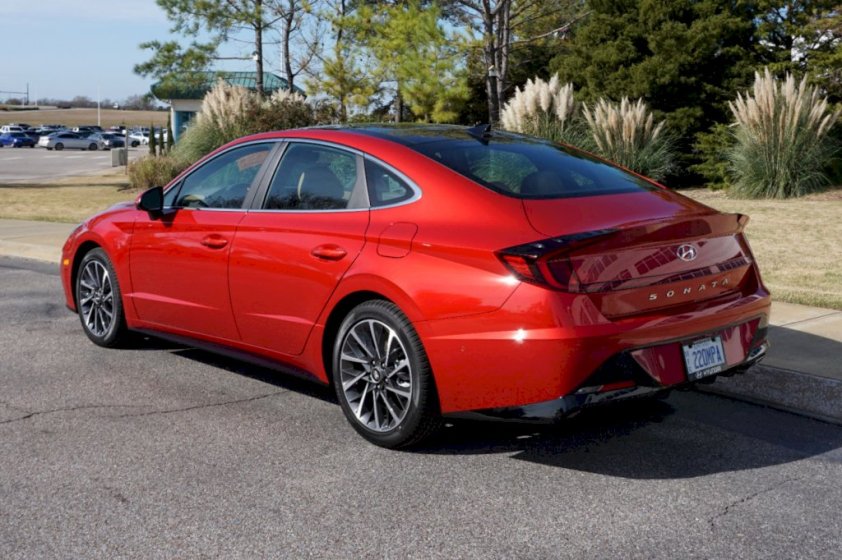
 2020 Hyundai SonataBrian Harper / Driving NEW ORLEANS It might seem that the entire buying public has abandoned the automobile in favour of crossovers and SUVs, but of course, that is not the case despite GM and Ford all but giving up on products that used to be their bread and butter. Sure, all-wheel-drive rigs have certainly taken the wind out of the car market, but there is still a solid following for the sedan, the coupe, and the hatchback.That Hyundai hasnt lost interest in chasing its share of the automobile segment is very much evident in the new, eighth-generation Sonata, its nearly full-sized (4,900 millimetres long) family sedan. The 2020 Sonata has shucked the latent styling conservatism of its predecessors, showcasing Hyundais sensuous sportiness design philosophy with a look that is sleek and indeed sensuous. Longer, lower, wider ironically a page from Detroits 1960s design philosophy the four-door is clearly set to challenge the market domination of the Toyota Camry, Honda Accord, and Nissan Altima.As one of Hyundais first and most successful nameplates, the companys design team wanted the Sonata to be special and memorable in all attributes, particularly styling, active safety and leading technology. Styling sees inspiration from the stunning Le Fil Rouge four-door-coupe concept shown at the 2018 Geneva Motor Show, the new Sonata profiling a similar coupe look, one that has worked so well for German automakers.The exterior exhibits what Hyundai calls performance-led proportions. That said, the Sonata which is just arriving at dealerships now is very much a family sedan, its powertrains competitive with those of its main rivals, albeit not class-leading. During the 2020 calendar year, though, Hyundai will bolster the model lineup with both a hybrid version, as well as a performance-oriented N Line model with 290 horsepower. For now, two engines are offered. The base Preferred 2.5L is powered by a normally aspirated 2.5-litre four-cylinder that turns out 191 horsepower and 181 pound-feet of torque. The other three models Sport, Luxury and Ultimate get turbo power in the form of the Smartstream 1.6 turbocharged and direct-injected inline-four. This new four-cylinder trades horsepower for low-end grunt (and better fuel economy) 180 horsepower at 5,500 rpm and 195 lb.-ft. of torque starting at 1,500 rpm. In both cases, the engines are mated to an eight-speed automatic transmission, one that uses shift-by-wire technology to eliminate the need for a physical gear lever. Furthermore, four different drive modes Smart, Normal, Sport and Custom make slight alterations to steering effort and engine/transmission mapping.Our 500-kilometre route first in a topline Ultimate model and then a Sport started at Hyundais manufacturing facility in Montgomery, Alabama, headed south through Mississippi to the Gulf Coast before making a hard right and following the coastline into New Orleans. The drive was mostly interstate highway, reinforcing the companys desire that the Sonata be treated as a family sedan. The speed limit on a good portion of the journey was 70 miles per hour, or 112 km/h, with much of the American pre-Thanksgiving traffic moving along at 10 to 20 km/h over the limit. Not only was the 1.6L turbo-four more than capable of keeping with the flow and easily accelerating up to speed when merging, it proved remarkably fuel-efficient. Just before running into rush-hour traffic on the outskirts of the Big Easy, the indicted fuel economy readout was registering a parsimonious 5.8 L/100 kilometres, the final reading pulling up the hotel still a thrifty 6.1.Hyundai notes the Sonatas smoothly efficient shape results in a coefficient of drag of just 0.27, with a flat under-floor covering and a range of body enhancements, such as small fins across each taillight that help improve fuel efficiency. The cabin was sufficiently quiet for the most part, with minor wind noise sneaking in at higher speeds. Hyundai engineers designed the Sonatas suspension to provide a quiet, solid ride at highway speeds, concentrating of chassis rigidity and improving response. The sporty-ish driving dynamics make the 2020 model more nimble than the outgoing car.The Sonatas interior, notably the Ultimate, has a rich ambience that matches the sedans exterior design. Sliding behind the wheel, the slim, full-width dashboard is dominated by a customizable 12.3 inch digital instrument cluster, and above the centre stack, a large, 10.25-inch high-definition touchscreen provides easy interaction with the infotainment system. This screen can also split to allow audio and navigation to be displayed simultaneously. All Sonata models, except the Preferred, include five years of complementary BlueLink services. Audiophiles will appreciate the 12-speaker Bose Premium sound system. Audio and EQ adjustments are made automatically, depending on the cars speed, while Boses Centrepoint surround technology and
Origin: First Drive: 2020 Hyundai Sonata
New Renault Captur: UK prices and specs announced for 2020 crossover
 Renault has revealed UK-specific pricing and specification detail for the new, second-generation Captur ahead of orders opening later this month. The Clio-based crossover, first shown to the public at September’s Frankfurt motor show, is priced from £17,595. That gets you a Play spec model with the base 1.0-litre three cylinder TCe 100 motor, which puts out 99bhp and 118lb ft of torque. Standard equipment for the entry-level model includes full LED headlights, climate control, cruise control, a seven-inch touchscreen with DAB, Android Auto and Apple CarPlay integration and keyless entry. Also included is safety kit such as lane departure warning, lane keep assist and active emergency braking. Stepping up to the TCe 130, which uses a 1.3-litre four-cylinder petrol engine, adds £2,800 – although in Play spec it’s auto-only, which explains the big price jump. Other engines include dCi 95 and dCi 115 diesel engines, (From £19,395 and 21,695 respectively) plus a range-topping TCe 155 petrol (from £22,895). Just three specification grades will be offered at launch, with Iconic (from £19,095) and S Edition (from £29,595) specs rounding the range off. The French maker claims to have sold more of the outgoing Captur last year than when it first launched in 2013. To continue that success, the new Seat Arona rival adopts an evolutionary approach to the exterior design that Renault describes as “more modern, more muscular and more expressive, with more SUV design cues”. The new crossover is significantly larger than its predecessor, with 100mm added to its length – with a 33mm longer wheelbase – and a 19mm increase in width. The result is claimed class-leading rear seat space, aided by a sliding bench that can be adjusted by up to 16cm, and a 536-litre boot that is 81 litres larger than the outgoing car. The Mk2 Captur sits on the same CMF-B platform first used for the latest Clio. It’s said to weigh “about the same” as the old car despite its increase in size and equipment levels, thanks to details such as an aluminium bonnet and plastic tailgate. The interior of the new car, like the Clio, has had a more substantial overhaul than the exterior. Renault claims it offers “a new dimension of quality and comfort rivalling models from the class above” with extensive use of higher-grade materials and newly designed seats. There’s also a new floating centre console, freeing up additional storage and space for wireless phone charging. The infotainment is a big upgrade, with an optional 9.3in central screen – larger than in the bigger Kadjar – combining with standard customisable 7in digital instruments (a 10in display is available on higher grades). A greater range of standard safety assist kit is offered, too. Renault is also going big on customisation: there’s a total of 90 exterior colour combinations and 18 interior configurations. From launch, the Captur will be offered with three turbocharged petrol engines and two diesels, all new to the car. The base 1.0-litre three-cylinder TCe unit puts out 99bhp and 118lb ft of torque, while a 1.3-litre four-cylinder makes 128bhp and 177lb ft in ‘130’ form, and 153bhp and 199lb ft in ‘155’ form. A 1.5-litre diesel comes in 94bhp and 113bhp form. Depending on the engine, five- or six-speed manual and seven-speed dual-clutch automatic gearboxes are offered. The Captur will gain a plug-in hybrid E-Tech model in the first quarter of 2020. The system, for which Renault has filed over 150 patents, blends a 1.6-litre petrol engine with a 9.8kWh battery and two electric motors, linked to a new ‘multimode’ continuously variable transmission, claimed to feel like a dual-clutch set-up. Renault says it can run for 28 miles on battery power alone at up to 83mph, while a braking system taken from the firm’s EV range allows strong brake regeneration for a ‘one pedal’ driving technique. Performance and efficiency figures have not yet been released, but engineers tell us it puts out around 150bhp and “substantially” more torque than the regular petrol
Origin: New Renault Captur: UK prices and specs announced for 2020 crossover
Despite federal rebate, Ontario’s electric car sales still haven’t recovered
 Alexis Georgeson demonstrates how to charge a Tesla model S electric car during a ribbon-cutting for Teslas first Ontario supercharger stations in Toronto , Ontario, Thursday,September 4, 2014.Postmedia Sales of electric vehicles in Ontario have plummeted since the Progressive Conservative government cancelled a rebate last year, hampering progress toward a national target.In the first six months of this year, sales in Ontario were down more than 55 per cent from the same period in 2018, according to data from Electric Mobility Canada.In the second quarter of this year 2,933 electric vehicles were sold in the province, down from 7,110 in the same period last year.Ontario is the only province not seeing increases in sales, year over year.Quebec and British Columbia, which have their own provincial rebates, have long been leading in total sales. Ontarios figures had been increasing on par with theirs until the provinces financial incentive disappeared.Under the previous Liberal government, Ontario had offered up to $14,000 back for buyers of electric vehicles, but Premier Doug Fords government cancelled it after winning the June 2018 election, saying it was going to people who could already afford expensive cars.Shortly after that, Ontarios sales sharply dropped and national sales did, too.They rebounded after the introduction this spring of a $5,000 federal rebate, but national sales of electric vehicles are still only at 3.5 per cent, which is a far cry from the federal governments target of 10 per cent in 2025. Its going to be challenging for the federal government to meet that target then even more by 2030 (when Ottawa hopes the number rises to 30 per cent), said Al Cormier of Electric Mobility Canada.If Ontario was in the game again it would make the whole thing a lot easier.B.C. is now at 10 per cent of sales, with Quebec close behind at seven per cent. In Ontario, electric vehicles made up around three per cent of total passenger vehicle sales at its highest point, then dropped to below one per cent after the cancellation of the provincial rebate, then climbed to sit under two per cent after the introduction of the federal rebate.Experts say rebates are key because the up-front cost of an electric vehicle can be anywhere from $10,000 to $30,000 more than a similar gas-powered car. Rebates take away some of that initial price shock, said Cara Clairman, the CEO of Plugn Drive, a not-for-profit devoted to electric vehicles.The total cost of ownership, when you take into account that youre not going to be paying for gas and theres less maintenance, she said. The total cost of ownership today is actually lower for an EV than for most gas cars.Transportation Minister Caroline Mulroneys office refused to make her available for an interview.A spokesman for Environment Minister Jeff Yurek later said the auto industry is giving people more options on electric vehicles than ever before.People have an individual choice and responsibility when they are purchasing their next vehicle and as charging infrastructure expands, we are confident there will be an increase in the uptake of electric vehicles, Andrew Buttigieg wrote in a statement.Clairman said a 2017 survey of about 1,200 drivers in the Greater Toronto Area found that price was a larger barrier to people purchasing electric vehicles than range anxiety peoples worry their electric vehicle will run out of power before reaching their destination.It helps that vehicle manufacturers are now coming out with models with a battery range of 400 kilometres, Clairman said, but more public charging infrastructure is still needed.In Ontario, the former government had put $20 million toward installing a network of 500 charging stations across the province. Nearly 350 of them were ultimately put into service, and the current government has not built any more. Metrolinx, the provincial transit agency, actually removed some earlier this year.Private companies such as Petro-Canada are stepping in to build charging stations and there are now roughly 1,400 public chargers in Ontario, according to federal and provincial data. Experts say more are needed.It would help, Cormier said, if the government put in place requirements for charging stations in new public buildings and garages. Earlier this year, the Ontario government removed a requirement for new homes to include the wiring for potential electric vehicle charging stations.Its not just that they havent supported building these things up, theyve actually got in the way of what we were already doing, said Dianne Saxe, Ontarios former environmental commissioner whose job was axed by the Ford government.Building denser communities that reduce the need for vehicle travel is the best bang for the buck, Saxe said, followed by public transit, followed by electric vehicles for transportation needs that cant be met the first two ways.Clairman believes the pace of electric vehicle sales will one day pick up in
Origin: Despite federal rebate, Ontario’s electric car sales still haven’t recovered
This 1918 Pierce-Arrow race car is made out of dessert
 A race car you can eat? Sounds like the perfect combination for an era when the drivers were fat and tires were skinny.The Broadmoor Resort in Colorado springs has been building the sweetest car in the world since 1964, and each year they choose a vehicle to replicate in dessert form.This year, their selection was a Pierce-Arrow Touring Car from 1918.The vehicle is special to the resort, as in 1922, it was transformed into The Broadmoor Special by owner Spencer Penrose, master mechanic Angelo Ciminp and chauffeur Harry McMillen.The vehicle would go on to compete in the Pikes Peak Hill Climb, where it took fourth place in 1926 and 1930.The time-lapse video of its construction shows 15 pastry chefs adorning the vehicle model with the tasty treats. It took two weeks to bake all the pastries.According to the Broadmoor Blog, the vehicle is composed of over 375 pounds of all-purpose flour, 425 whole eggs, 300 pounds of dark chocolate, 47 pounds of molasses, 412 pounds of butter and myriad other ingredients.The car looks impressive, but wouldnt have happened if it werent for the two magical wood workers that made the frame for the cookies to sit on.The real vehicle will be on display at the Penrose Heritage Museum, which is open Monday through Saturday from 9 to 5 pm and Sunday from 1 to 5pm. The museum is owned and operated by the El Pomar Foundation, a charitable foundation established by Spencer and Julie Penrose in
Origin: This 1918 Pierce-Arrow race car is made out of dessert
Mini is bringing back its manual transmissions
 2019 Mini Cooper 3-DoorPeter Bleakney / Driving For many years, small hatchbacks have been characterized by their fun-to-drive nature, and most will agree nothing is more fun to drive than a car with a manual transmission.Mini agrees, and so its bringing back its manual transmission option for most of its vehicles after a brief hiatus.Starting early February 2020, customers will be able to resume ordering (two- and four-door) Mini hardtop and convertible models equipped with manual transmissions from March 2020 production, spokesperson Andrew Cutler told Car and Driver.With take rates for manual transmission vehicles landing in the lower echelons, Mini actually manages to garner more attention from purists than other brands. According to Mini, the Cooper Hardtop S has a manual transmission take rate of 45 per cent, which is astounding in this day and age. There is a segment of the customer base that prefers driving with a manual transmission, so we do want to maintain that for the component of our customers who expect that, said Cutler. We are going to continue to ensure that weve got manuals when and where possible.The reason for the hiatus in North America was an update to the fuel-delivery system, which enhanced efficiency. The testing that occurred left the seven-speed dual-clutch transmission and the eight-speed automatic as the only options.Unfortunately, the transmission will not be returning to every model. Those left out will be models with all-wheel-drive and the John Cooper Works editions, which require a more stout transmission to handle their added
Origin: Mini is bringing back its manual transmissions
First Drive: 2021 Mercedes-AMG GLE 53 Coupe
 2020 Mercedes-AMG GLE 53 CoupeCosta Mouzouris / Driving INNSBRUCK, Austria The amount of snow near Innsbruck in late November was astounding. Along some mountain roads, it was piled three metres high, proving a nearly ideal setting to test the 2021 Mercedes-AMG GLE 53 Coupe especially since lower elevations provided more temperate conditions, enabling an all-season test in a day.The new GLE Coupe has received a significant update, and has grown in the process. Wheelbase and overall length are 20 and 70 millimetres longer, respectively, than the current model, though wheelbase is still shorter than the GLE SUV, at 2,935 mm. Rear passengers get 35 mm more legroom, and theres more cargo space.Storage capacity in the cargo area is 655 litres, which expands to 1,790 litres with the rear seats folded; the latter is an increase of 70 litres compared to the outgoing GLE Coupe. This compares to 630/2,055 litres for the GLE SUV, so the sloping roofline does extract a cost in total luggage capacity. It also limits headroom for rear passengers; a six-footer like me just barely clears the headliner. The loading deck is 60 mm lower, and to further ease cargo loading the GLE can be lowered another 50 with the press of a button.The GLE Coupe gets a new 3.0-litre turbocharged inline-six that produces 429 horsepower and 384 lb.-ft. of torque. This is an increase of 44 horsepower over the current GLE 43, though the torque figure is the same. The GLE 53 gets an additional boost in power through a 48-volt electric starter-generator mounted between the engine and transmission, which briefly adds 21 horsepower and 184 lb.-ft. of torque under hard acceleration. Combined electric and gas power push the GLE 53 from zero to 100 km/h in 5.3 seconds, almost a half-second quicker than the GLE 43. A nine-speed torque-converter automatic drives all four wheels via a variable all-wheel drive system. The engine combines a conventional exhaust-driven turbocharger with a 48-volt electric turbine to boost intake pressure. The latter spools up instantly when the gas pedal is depressed, and as the engine picks up revs the conventional turbocharger takes over, providing seamless power deliver free of turbo lag.Two off-road drive modes (Trail and Sand) have been added to the existing Slippery, Comfort, Sport, Sport Plus, and Individual modes. The two Sport modes lower suspension by 15 millimetres, and when in Comfort mode, it lowers only when travelling above 120 km/h to reduce drag. Suspension can also be raised 30 mm from standard for additional clearance when driving off road or in snow.The interior is well appointed, roomy and comfortable, and made even more airy by the standard panoramic sunroof. Rear visibility is hampered by the small rear windows, especially noticeable when looking at the rear-view mirror. On the dashboard, youll find a wide, seamless pane of glass behind which is a pair of Mercedes now-familiar 12.3-inch displays. The forward display features the configurable instrument panel, and the display above the air vents is a touchscreen, which forms part of the GLEs MBUX infotainment system that also uses steering wheel controls, a touchpad on the centre console, and voice commands to initiate various functions.The centre screen shows entertainment, navigation, and vehicle setting info. Augmented reality navigation is standard, and it overlays navigational instructions on a real-time forward view. It works fine, but is distracting when trying to navigate complex intersections; I find regular simulated navigational prompts are easier to follow, as long as theyre timely, which with Mercedes system, is the case. Most manufacturers are moving to smaller Type-C USB ports, and there are five of these ports in the cabin. A wireless phone charger in located just ahead of the cooled and heated cup holders in the centre console. Android Auto and Apple CarPlay are included.Due to record early season snowfall in the Alps, a scheduled snow drive had to be reduced to just a few kilometres, though it was along an icy road flanked by a steep drop. While the GLE 53 handled the slippery, icy surface with ease while in Slippery mode even when prompted by two-way radio to hammer the throttle the drive was just too short to really assess its winter driving capabilities. They are no doubt exemplary, especially when equipped with Pirelli Scorpion winter tires, as was my tester.At lower elevations on dry pavement, the GLE performed admirably, returning a taut ride. The GLE 53 has Active Ride Control Plus to control body roll; it uses split anti-roll bars that incorporate electrically controlled servos to actively lean the vehicle into turns, like a motorcycle. The ride control is adjustable to three levels and you can feel it leaning in the most aggressive level.The GLE, however, feels rather hefty. This was especially noticeable when accelerating to make a pass, where it felt like maybe 50 horses werent contributing
Origin: First Drive: 2021 Mercedes-AMG GLE 53 Coupe
BMW will install Android Auto on its cars beginning 2020
 BMW M135iBMW BMW is finally adding Android Auto compatibility to its cars beginning mid-2020, the German automaker said mid-December.Starting in July, BMW owners will be able to hook up their Android-powered devices to their car, and, as long as the vehicles running version 7.0 of its multimedia interface, theyll even be able to do so wirelessly.The integration means those devices can also be synced to the cars digital instrumentation systems, and even the heads-up display. The roll-out will begin in 20 countries in July 2020, then hit additional markets after that.The announcement comes hot on the heels of BMWs Apple CarPlay policy reversal; it has, in most markets, charged a subscription fee to connect to the software, but will now, like basically every other automaker, make such integration
Origin: BMW will install Android Auto on its cars beginning 2020
New Fiat 500e: electric city car seen inside and out in new shots
 Fiat’s all-new, all-electric Fiat 500 city car has been caught testing again ahead of its expected 2020 Geneva motor show debut. The new prototypes, clearly based on the outgoing model, don’t reveal much about the new car’s exterior. They do, however, offer the briefest of glimpses into the car’s cabin. We can see the Mini Electric rival’s dashboard has been completely overhauled, with new instruments and a large central infotainment screen visible. A new rotary gear selector also features, mounted on a plinth below the centre console and surrounded by buttons. Earlier this year Fiat said it would invest 700 million Euros on the electric city car, to include a new production line in Mirafiori, Italy. Fiat hopes to produce 80,000 examples of the new 500e. The car will be sold alongside the existing 500, which will continue to be powered by conventional petrol engines as well as receiving styling and technical updates. The all-new electric 500 will sit on a bespoke electric car platform, according to Fiat boss Olivier Francois, with the same platform potentially earmarked for use if the the new Panda-inspired Centoventi concept makes production. The electric 500 will be a key part of Fiat’s transformation in Europe into a brand focusing on small electrified city cars. “The car will stay true to everything you know about the 500, but will be entirely new,” said Francois. “Under the skin it will be radically different, but otherwise you will recognise the size and proportions. “But it is a big statement, starting our electric path with the 500. We are doing it with that car for reasons of pricing. It is clear that we cannot sell an electric 500 for the same entry price of today’s 500, but what’s clear is that more than half of our 500 customers today do not buy entry-level models. In fact, for them a 24,000 euro price is normal today. “If you look at our electric competition, they are priced around 32,000 euros. The leap then from 24,000 to 32,000 is not so much, especially if you factor in government grants for electric vehicles. Francois refused to be drawn on whether the electric 500 could be rear-wheel drive like the original, but said he would be open to the idea. He also said that an electric Abarth model could hold appeal. The electric car platform that the 500e will sit on will be FCA Group developed. Francois said he would personally be open to sharing the technology with partners – the 500 platform has previously been shared with the Ford Ka, for instance, but he stressed that any such decision would have to be made at a Group level. Fiat also confirmed the 500 lineup will be expanded with a 500 Giardiniera estate, although the firm didn’t say if that version would also appear at next year’s Geneva show. The aim is to consolidate the brand’s dominance of the city car segment – the 500 and Panda hold a third of this market – while developing technologies that allow these models to satisfy emission regulations. The 500 Giardiniera, which references the tiny wagon of 1960, will offer the best space efficiency in its class, says Fiat, and “unmistakable design”. It too will get electric and mild hybrid variants. The 500’s new platform architecture can also cope with a mild hybrid system. That unit consists of a belt driven, 12V starter-generator, although little detail has been provided on the electric drivetrain to be used in the 500. Lower-emissions petrol engines will also be offered in the 500 and Panda. Francois conceded that the decision to develop the electric cars was driven “both by the desire to create a profitable electric car for our future, and to ensure we avoid the pressures of potential fines if we don’t hit CO2 targets.” Given the limited space for batteries and the 500’s urban appeal, range of the 500e is likely to be less than EVs such as the Nissan Leaf, which offers around 250 miles. The 500e will be a rival to a growing number of small EVs – Mini’s first series-production electric car is due in 2019, at the same time as the Honda Urban EV. The 500e will be one of four electric powertrains offered by FCA. It will sit use a ‘City Car’ powertrain, while a ‘Mainstream’ powertrain will be launched in the Jeep Grand Commander. A ‘Performance’ powertrain will feature in the 2020 Maserati Alfieri and a ‘Premium’ EV powertrain will power the 2022 Maserati Quattroporte. The push for electrification comes amid Fiat Chrysler’s abandonment of diesel; by 2022, there will be no diesel options in the FCA catalogue. These will be replaced by numerous hybrids, both full and plug-in, the first of which will be the new Jeep Grand Cherokee, landing in 2020. The production capacity released by the deletion of the Punto and other unspecified Fiat models – such as Tipo – will be used to build more Alfa Romeos and Maseratis, whose premium prices can withstand the electrification costs. Some Italian capacity will be used to build some plug-in hybrid models, including
Origin: New Fiat 500e: electric city car seen inside and out in new shots
We take on some of Atlantic Canada’s worst roads in a new Cadillac
 In most parts of the country, carping about the state of this nations roads is an art form. New expletives have been crafted solely for use when ones brand-new set of winter tires slam into an unexpected pothole. Fillings have been jarred loose by washboard road surfaces. Alignment mechanics rejoice the former, dentists do brisk business with the latter. Hey, at least someone is making bank off our rough roads.Yelling into a vacuum yields little, so CAA holds an annual campaign in which Canadian road users including cyclists, pedestrians, motorists, and users of public transit are encouraged to cast a vote for what they feel is the worst road in their region. Every road is eligible, regardless of surface type or length.Across Canada, wild temperature swings and an abundance of road salt conspire to scupper even the best paving job. Jagged lines cut every surface like a botched episiotomy, with macadam crumbling like day-old sponge cake. Armed with CAA’s list of Ten Worst Roads in the Maritimes and the keys to a 2020 Cadillac XT6 crossover, we decided to seek out these potholed pavements in an effort to gauge the state of our roads.Would the Cadillac provide a comfortable journey? Will this infrastructure hammer our spines into oblivion? Did I make a theme-based playlist filled with The Stones and the score from Rocky?The answers to those questions were yes, no and an emphatic yes.Our pothole-tamer: the Cadillac XT6First, the Cadillac. The luxury arm of General Motors has been fiddling with their Standard of the World for a few years now, rolling out two new sedans and three new crossovers in quick succession.The XT6 is the largest of these, acting as a draw for customers seeking a snazzy three-row machine with all-wheel-drive. Cadillac already has a three-row SUV in its quiver of course, but the large-and-in-charge Escalade scares away some customers thanks to its bulk and truck-based roots. For anyone trading out of an Acura MDX or Volvo XC90, the XT6 will be much more approachable.Outside, the Cadillac certainly looks the part, with our Sport-trimmed tester dipped in $900 worth of inky Stellar Black Metallic paint. Unlike the Premium Luxury models, the Sport eschews all exterior brightwork save for a spear along its lower flanks and one edging the perimeter of its front grille. A completely blacked-out grille, bookended with headlights narrowed like the eyes of a stern headmaster, is a dealer-installed accessory and should be fitted to every XT6 regardless of colour.Pine Glen RoadPointing the long XT6 nose containing a 3.6-litre V6 engine making 310 horsepower towards New Brunswick, we set off in search of what CAA has deemed to be some of Atlantic Canadas worst roads. Plugging the street of Pine Glen Road just outside of Moncton into the Cadillacs satnav is easy thanks to recent changes. Now deploying a rotary dial incorporating jog functions into the system, CUE is no longer an exercise in frustration.The drive to Pine Glen Road is an exercise in cutting through early morning fog on the Cobequid Pass, a stretch of road notorious for its pristine pavement but reliably horrid weather. With no sinkhole (yet) consuming the Trans-Canada Highway near Oxford, we carried on to Moncton, the land of St. Hubert and Jean Coutu pharmacies.Turning on to Pine Glen Road, a long stretch connecting far flung communities with the city of Moncton, we find pristine pavement. A quick check of the satnav confirms we are indeed on the correct path, even if the macadam were traversing looks as far from a Worst Road contender as your author looks like a Chippendale model. What happened?Councils take the CAA Worst Roads lists seriously, is what happened. A few clicks down Pine Glen Road we happen upon a large road crew, feverishly laying new tar atop the old crumbled surface. Stopping to chat with the site foreman, he explained theyve been on the job since August, upgrading a road thats heavily travelled by woods trucks and the general public alike.Using heavily calloused hands to adjust his white hard hat, the man looked proud to be working on the project. If the sign posted by a local church is anything to go by, locals are pretty proud as well.All good things must come to an end, of course, and the new pavement disappears as one drives deeper into Pine Glen Road. By the time were out of the residential areas and into the wooded areas, its easy to see why this road made CAAs top ten. Its most heavily travelled section, however, is now billiard-table smooth thanks in no small part to The List and a crew of hard-working pavers.Working the lozenge-shaped shifter to handle a three-point turn in a roadside cutout was more frustrating than strictly necessary, given the button-and-lever dance one has to do in order to engage reverse gear. GM is not likely to change its design anytime soon, since the thing has popped up in everything from this Cadillac to Buicks to the Chevy Bolt. Electronic shifters are tremendous,
Origin: We take on some of Atlantic Canada’s worst roads in a new Cadillac
UKs first zeroemission street to trial in London
 UK’s first zero-emission street to trial in London Beech Street in the City of London will ban petrol and diesel vehicles London will open the UK’s first zero-emission street, as Barbican Estate’s Beech Street is set to ban petrol and diesel vehicles. The City of London Corporation is working on Transport for London plans for no environmental disruption from vehicles, cyclists, and pedestrians by spring 2020. The move will be possible with an 18-month experimental traffic order, allowing air quality and traffic to be monitored. Exemptions will include emergency vehicles, access to car parks off Beech Street, and for refuse collection and deliveries. The 153 bus route which runs along the street is fully-electric and unaffected by the changes. Beech Street experiences high levels of air pollution since it is a busy route and enclosed. The ban is expected to significantly improve air quality in the area, with particular focus on nearby schools. The trial will also be used to consider whether similar measures are suitable for other streets within the City of London. To be able to access the street other than under the above exemptions, vehicles will need to comply with TfL’s Cleaner Vehicle Discount for the Congestion Charge. This sees a maximum CO2 limit of 75 g/km, minimum 20 mile electric-only range, and Euro 6 equivalent NOx standard. Signage and warnings will be set up prior to the boundaries, and traffic will be enforced using automatic number-plate recognition cameras, with a penalty charge issued should regulations be broken.
Origin: UKs first zeroemission street to trial in London
 All about car