 Mercedes-AMG GLA 35 4MATIC (Kraftstoffverbrauch kombiniert 7,5-7,4 l/100 km, CO2-Emissionen kombiniert 171-170 g/km) // Mercedes-AMG GLA 35 4MATIC (combined fuel consumption 7.5-7.4 l/100 km, combined CO2 emissions 171-170 g/km) Mercedes-Benz is updating its lineup with the introduction of the refreshed 2021 Mercedes-Benz GLA, the entry-level SUV in the brands successful family of SUVs.The new Mercedes-Benz GLA is ten centimetres taller than its predecessor, to offer more headroom for the driver and passenger; legroom has been improved in the rear as well.The rear seats can be moved fore and aft, and the bench is a 40-20-40 split-folding type.The front section of the GLA is upright, while the overhangs have been made shorter to allow for more off-road prowess, while simultaneously making it easier to park. The wheelbase has been lengthened to 2,729 millimetres, 30 more than the previous generation. Under the hood of the GLA is a 2.0-litre four-cylinder turbocharged engine that makes 221 hp and 258 lb.-ft. of torque. Power is sent to either the front or all four wheels via a seven-speed automatic transmission.Opt for the AMG 35 version of the GLA, and that powerplant delivers 302 horsepower and 295 lb.-ft. of torque. The transmission for the A35 is an eight-speed dual-clutch automatic, which helps it get to 100 km/h in just 5.1 seconds. Top speed is an electronically limited 250 km/h. All versions of the vehicle have a fun party trick carried over from the full-sized GLS called Car Wash Mode, which folds the mirrors and closes all the windows, including the sunroof, and also turns off the rain-sensing wipers so they arent triggered by the water.The GLA is set to arrive in Canada by summer of
Origin: Mercedes-Benz updates lineup with refreshed entry-level GLA
CUSMA trade deal could keep auto jobs in Canada, but car prices could rise
 Workers are seen at the FCA Windsor Assembly Plant on Oct. 5, 2018 in Windsor.JEFF KOWALSKY / AFP/Getty Images A new trade deal between Canada, Mexico and the United States has taken a major step toward implementation, and it looks like it could be good news for the auto industry.The agreement which the Canadian government calls CUSMA (Canada-United States-Mexico Agreement) but which the U.S., unsurprisingly, refers to as the USMCA will replace NAFTA (the North American Free Trade Agreement), which has been around since 1994.All three countries had tentatively agreed on the deal in 2018 but wanted several amendments, including on automotive rules of origin.The two American political parties have finally agreed on the terms, while Chrystia Freeland, Canadas Deputy Prime Minister, signed on to the amendments yesterday. Mexico has also stated it is satisfied with the new agreement.The CUSMA deal now has to be ratified by all three countries, which could potentially happen as early as the end of 2019. In the U.S., General Motors and Ford issued statements approving the deal, as did the president of Canadas Unifor auto workers union, who told Automotive News Canada that it could level the playing field between Canada and Mexico.Among the agreements rules are a requirement that 70 per cent of the aluminum used in North American-built cars be of North American origin. The amount of domestic steel is also mandated, and the amendment tightens up the definition of exactly what constitutes North American steel.Under NAFTA, 62.5 per cent of a cars components had to be made in North America in order to move duty-free between the three countries. Under the new agreement, that will rise to 75 per cent by 2023. The deal also prevents the U.S. from imposing future tariffs on specified numbers of Canadian- and Mexican-built auto parts.At least 30 per cent of a vehicle must be made by workers who earn more than US$16 per hour, and Mexican workers will have the right to demand fair pay and freely form unions. An inter-agency committee will be put in place to inspect factories suspected of having poor working conditions an amendment to the original deals provision for U.S. officials to enter and inspect Mexican facilities, which Mexico opposed.Its expected this agreement will keep more auto jobs in Canada and the U.S., rather than seeing them moved to Mexico. However, some experts say this could cause car prices to rise and to reduce the number of smaller vehicles available to buyers, since many of these are currently made in
Origin: CUSMA trade deal could keep auto jobs in Canada, but car prices could rise
An Infiniti dealership sells a Tesla to Sherbrooke’s mayor – and everybody goes crazy
 Now that is customer service: Steve Lussier, mayor of Sherbrooke in Quebec Eastern Townships, was ready for a new car, and as a hybrid vehicle owner for the past 15 years, wanted something electric.But his long-trusted Infiniti-Nissan dealership the one he bought his Infiniti Q50 Hybrid and (rare) Nissan Pathfinder Hybrid (still owns it) from didnt have a new 100-per-cent electric model to offer him.Odds are it wont for another two or three years.So the dealership pulled some strings and got him what he wanted, a used 2018 Tesla Model 3 with just 30,000 kilometers on the clock, traded in by a local businessman.In one day, the transaction was done, says Lussier, who took delivery of the well-equipped full-electric sedan last Friday. I still have discover some of its features its such an advanced-techno car but for now, I very happy about it.Our story would normally end here, but Infiniti Sherbrooke posted about the deal on its social media and inadvertently inspired numerous blog posts blowing the whole thing up headlines along the lines of mayor turning green or Infiniti dealership admits it doesn’t have electric models.The dealerships Facebook page was flooded with comments about how the brand, in an effort to retain a loyal customer, instead lost him to Elon Musk, or how Infinitis doing Teslas marketing for it.Jean-Sbastien Poulin, co-owner of Infiniti de Sherbrooke, cant believe all this fuss when, bottom line, his client wanted an electric car. Infinitis brand doesnt have yet an electric car. So I found a solution.There are plenty of dealerships that sell other brands vehicles to accommodate their customers why all these roadblocks suddenly thrown at us?And of course, Infiniti isnt the only luxury brand without a pure electric offering. Try shopping for EVs at Acura, Mercedes-Benz, Lincoln, Cadillac, Land Rover or even Lexus, the haut-de-gamme arm of hybrid hype-builder Toyota. Yes, Lussier could have bought an Infiniti-adjacent Nissan Leaf, a good vehicle (he) recently test-drove for a whole week, but he says its not where I wanted to go. Ditto the thought of heading to Sherbrooke BMW for a new i3.He wasnt content waiting a year on an admittedly attractive new Polestar, and could have been lured into a Jaguar I-Pace if the brand had had staff on hand to answer his questions when he visited the Salon du véhicule électrique in Saint-Hyacinthe last October. Oops.But then, Lussier was already hooked on a Tesla anyway. I put a $1,000 a year ago to reserve a brand-new one, he told Driving.ca. After a test drive last summer, he fell in love with the Californian electric sedan. One of my municipal councillors already owns one, and he loves it, too.Lussier didnt suddenly turn green either. (Next week at city hall,) we are going to announce additional funding to help our citizens finance their home EV-charging stations, the Mayor confided to this author.We have been doing so with a $500 municipal subsidy since 2013, but it became so popular, with more than 300 requests a year, we had to review the budget allowance. So well reveal something else next Monday.Even greener, Lussier says hes set to purchase his first electric motocross bike from the local Valcourt Bombardier (BRP), which last February bought up the now-defunct California-based Alta all-electric motorcycle company.Asked if he will eventually buy an electric Infiniti when they hit the Sherbrooke showroom, Lussier says Im eager to test-drive what my dealership will offer, but if ever I want to buy another Tesla, I know that once again, it will accommodate
Origin: An Infiniti dealership sells a Tesla to Sherbrooke’s mayor – and everybody goes crazy
First Look: 2021 Chevrolet Suburban and Tahoe
 2021 Chevrolet Tahoe RSTDerek McNaughton DETROIT, MichiganThe Chevrolet Suburban the SUV that stamped the segment into existence some 85 years ago is finally moulting its 2014 body and frame, replacing it with a roomier, more technologically advanced and seriously more comfortable three-row utility that takes inspiration from the new Chevy Silverado.The favourite SUV of law enforcement, governments and big families everywhere, the 2021 Suburban and Chevrolet Tahoe debuted in Detroit Tuesday with all-new exteriors, a new platform and substantially revised interiors, offering much more cargo space along with better access to the third row.Perhaps the biggest change, however, is underneath. Riding on GMs T1 platform, the two Chevrolets say goodbye to a solid rear axle that has been a hallmark of these vehicles for decades. While the solid axle gave these body-on-frame SUVs great towing ability, it also meant a noticeable truck-like ride and loss of cargo space, not to mention high load floor. A new, independent rear suspension with optional Air Ride Adaptive Suspension on all four corners, lowers the cargo deck more than five inches, frees up cargo space and provides a massive improvement in the driving characteristics of this full-size rig. On a quick and short ride-along at GMs Milford Proving Grounds, the 2021 Tahoe with air suspension and Magnetic Ride Control felt seriously well-composed over rough roads for a vehicle that has grown in wheelbase and overall length.For those Tahoes and Suburbans without air ride, a standard shock-and-coil-spring set-up underpins the ride, while Magnetic Ride Control is available on other up-level trims. The air suspension is an open system with a compressor in the rear and air drier along with 7-litre storage tank. It can raise the SUV two inches for off-road travel, or lower it another two for ease of entry. The Tahoe sees, perhaps, the biggest improvement, growing almost seven inches in overall length, gaining three inches of legroom in the second row, and more than 10 inches in the third. Maximum cargo jumps from 94.7 cubic feet to just shy of 123, almost enough to fit two fridges inside. The Suburbans maximum cargo grows to a cavernous 144.7 enough to embarrass a minivan.For the first time, Tahoe and Suburbans second-row seats slide fore and aft, moving 10 inches forward or rearward. Second- and third-row seats also fold more easily. Engine choices also expand. The previous Suburban and Tahoe offered a 5.3-litre EcoTec V8 with 355 horsepower or a 6.2L EcoTec V8 with 420 hp; the new units get those same engines plus the addition of the diesel that just debuted in the Silverado and Sierra pickups. Both gas engines feature Dynamic Fuel Management, with more than 12 modes of cylinder deactivation. The 6.2 comes standard on the new High Country trim. All three engines are mated to a 10-speed automatic transmission.The diesel, however a 3.0L in-line six that produces 277 horsepower but a whopping 460 lb.-ft. of torque is as smooth as it is quiet, with remarkable efficiency to boot, likely giving Tahoe and Suburban the best fuel economy in the segment that includes the Ford Expedition, Nissan Armada and a few others. Later, the Silverado and Sierras 2.7-litre turbocharged four-cylinder with 310 horsepower is also expected to be available for fleet buyers.Inside, the interior takes evolutionary steps with a standard 10-inch colour infotainment screen. With electronic buttons for gears replacing the old column stalk shifter, the interior is far more modern without looking instantly dated like the interiors of the pickups. <img src="/uploads/img/auto-news/44-first-look-2021-chevrolet-suburban-and-tahoe.jpg" alt="First
Origin: First Look: 2021 Chevrolet Suburban and Tahoe
First Drive: 2021 Audi RS 6 Avant
 2021 Audi RS 6 AvantBrian Harper / Driving MALIBU, Calif. To a casual observer, the view from the second-floor patio of the Surfrider Hotel provides a glimpse of the state of personal mobility in and through Malibu, home to many of Hollywoods elite and featuring some of the most desirable and expensive property in the state. Directly below the patio is the Pacific Coast Highway (better known as the PCH, or more formally, State Route 1), this four-lane stretch of tarmac through the city sees almost as many Porsches as Priuses, with Teslas clearly the wheels of choice for a good percentage of the moneyed locals. The occasional Rolls-Royce glides by, ditto Maseratis, Range Rovers, Volvo SUVs and various models of Mercedes, among far more proletarian product. But not a single Audi RS 6 Avant until today.A rare ride even in Europe, where the ber-sportswagen has achieved iconic status among the performance cognoscenti, the RS 6 Avant will finally reach North American shores in late 2020, a year after it shows up in Europe. Replete with Audis highly regarded Quattro all-wheel drive system, an eight-speed automatic transmission, and a twin-turbocharged 4.0-litre V8 with a 48-volt mild hybrid system and 592 politically incorrect horsepower, the sleek yet muscular Avant wears sheet metal no crossover or SUV can out-sexy. A family hauler for the Fast and Furious set? Or, considering the venue, the ultimate surf woodie, minus the wood? Yes and yes! This Avant is the fourth-generation RS 6 for Europe and other markets, but the first generation Canadians will see. And Audi is not skimping on the features, loading up the wagon with all manner of performance and handling technologies, top-level infotainment and connectivity devices, and swaddling the cabin in appropriately tasteful materials and trims. Though Audi will not be limiting production, its cost will ensure exclusivity; pricing wont be finalized for Canada until closer to the cars arrival date, but Mercedes-AMGs 2020 E 63 S wagon the Audis closest rival starts at $120,000. So, judge accordingly.The RS 6 Avant isnt merely a hot rod version of the A6. With the exception of the front doors, roof and tailgate, the RS exterior is made up of RS-specific parts. In addition, the Avant has been widened around 40 millimetres on each side with flared wheel arches, the better to emphasize the meaty P285/30ZR22 Pirelli P-Zero tires and killer wheels. A power dome augments the hood, and the RS 6 adopts the front headlights from the A7 Sportback. Below the lights, side air inlets open on the bumper and extend almost into the lower edge of the headlights, the Avants designers taking their cue from the front end of the R8 sports car. The stylish rear end consists of a roof-edge spoiler and an RS-specific bumper with rear diffuser. In typical RS style, the exhaust system flows into chrome oval tailpipes, or in the case of the optional sport exhaust system highly recommended, by the way black tips.The bright Tango Red tester waiting for us was loaded with all the necessary equipment to scorch the twisting and undulating canyon roads feeding the PCH. RS Sport suspension with Dynamic Ride Control, replacing the standard adaptive air suspension? Check. Dynamic Package Plus, adding four-wheel steering, massive ceramic brakes, and jacks up the wagons top end to a super-illegal 305 km/h? Yep! Customizable drive modes to tailor the car to the road and the driver to the car? Thumbs up! Oh my, the gods of vehicular hooliganism do smile upon this beast. At just under five metres in length, the body style is clearly mid-sized wagon, but the power, acceleration, feel, and grip say five-seat sports car. Understand that some of these canyon roads Mulholland Highway, Stunt Road, and Decker, Latigo, and Malibu Canyons have been the holy grails for SoCal enthusiasts for decades; the RS 6 Avant is as adept at finessing these asphalt jungle gyms as the two Lamborghini Huracans we encountered on our runs. The cars four-wheel steering meant no full-lock heroics were needed on even the tightest decreasing-radius turns. The slightest touch of the brake pedal scrubbed off speed when needed, and the Audis ability to hold the intended line, regardless of speed or change of road direction, had both my co-driver and I swearing in disbelief. Punching the throttle pinned us both back in our seats Audi claims the 2,075-kilogram RS 6 Avant will hit 100 km/h from a standstill in 3.6 seconds honestly, it felt faster.Still, such behaviour is frowned upon by polite society as well as the local constabulary, meaning if you value your drivers licence, the RS 6 is more likely to be used as a grocery getter or for schlepping the kids to soccer practice. Its quite capable of being civil when doing so, but the one concern we discussed while cruising up the PCH in an air suspension-fitted model was that, despite occasional bumps and ripples, California roads are free of the
Origin: First Drive: 2021 Audi RS 6 Avant
SUV Comparison: 2019 Honda CR-V vs 2019 Toyota RAV4
 Jonathan: While these two little rigs might not set blistering lap times, raise the bar for torque or towing, travel hundreds of kilometres on free electrons, or even get hearts racing, they are the true giants of the Canadian auto industry. Coming from the incredibly popular compact crossover segment that they created, we are here to pit the Toyota RAV4 against its archival and longtime nemesis, the Honda CR-V. The RAV4 is fresh from a complete redesign for the 2019 model year, so the CR-V, a couple of years into its generational cycle, has its work cut out for it to claim superiority over a rival with all the latest tech and gadgets. And as these things go, both are indeed loaded to the roof rails with every gadget and feature available to each model line, the CR-V showing up in Touring trim at $39,090 plus a $1,795 freight and PDI charge. The Toyota RAV4 is a Limited AWD model, ringing in at $40,690 with $1,815 for freight PDI, and while it is fully loaded, there is a more expensive RAV4 out there if you opt for the same trim with a hybrid powertrain ($42,090 + PDI). Those prices are practically a dead heat, so each will prove its value through merit, showing its practicality, feature content and engineering excellence.Peter: Indeed, these two Ontario-built sales champs have a lot in common near identical exterior and interior dimensions and power ratings but they sure feel different on the road. By the numbers, the Toyotas 2.5L naturally aspirated four cylinder outmuscles the Hondas 1.5L turbo four 203 horsepower and 184 lb-ft of torque vs 190 horsepower and 179 lb-ft of torque. So the Toyota RAV4 is more fleet of foot, right? Uh, no.The Toyotas engine doesnt find that torque peak until a rather thrashy 5,000 rpm, whereas the Hondas shove comes on board at a more usable 2,000 rpm. In the cut and thrust of day-to-day driving, the Honda is the more relaxed and quiet crossover, moving forward on a nice easy shove of mid-range torque. The Toyota always feels and sounds like its working hard, and youre going to want to plan your highway merging. I got caught flat-footed, with my foot flat to the floor.That said, the RAV4 settles down into a quiet, stable and comfortable cruiser, and the eight-speed auto works well when not pushing hard, shifting smoothly and making the most to the engines power. The Honda CR-V is fitted with CVT (continuously variable transmission), but under most circumstances youd never know it. Again, its the little 1.5L turbo-fours low-end torque that keeps things moving along with little drama.JY: Actually, after spending a bit more time behind the wheel of the RAV4 after filming, there were occasions when that lack of low-end torque and the efficiency goals of the transmission led to some rough downshifts under hard acceleration. The 8-speed went looking for a lower gear to deliver the kind of urgency my foot was calling for, but it couldnt get out of its own way. Despite the Sport button on the console, the RAV4 simply does not like being driven quickly. Eventually I learned to accept its limitations, but it required resetting my more sporting style of driving to something far more patient, and I equally doubt that the extra AWD settings (Rock and Mud Sand) will get any use at all from the typical RAV4 owners. Save it for the 4Runner, Toyota. Once I started driving the RAV4 within its comfort zone, it shone. It is plenty comfortable around town and settles in nicely at highway speeds, and has excellent visibility and good steering response making it easy to maneuver around town. You could say the same of the CR-V, which might have a touch better steering response and comfort, but both are respectable and dialled in nicely for a compact crossover. Both cruise quietly and with great stability on the highway, with adaptive cruise and other driver aids to help alert you to dangers around you and take action if necessary.It should be noted for value shoppers that adaptive cruise, lane departure alert, lane keep assist, forward emergency braking, plus blind-spot monitoring and rear cross-traffic alert are standard equipment on the base $27,990 RAV4, but those features dont come into play until the $31,686 LX AWD model on the CR-V. At the top of the lineup, the one big edge I gave to the RAV4 is the 360-degree parking camera (the CR-V has just a multi-view rear camera) that makes parking a breeze in any situation, especially crowded mall parking lots or tight underground garages. <img
Origin: SUV Comparison: 2019 Honda CR-V vs 2019 Toyota RAV4
2020 Fisker Ocean can gain 200 miles of range in 30 minutes
 American start-up Fisker has announced a partnership with Electrify America that will give drivers of its 2020 Ocean SUV access to “the largest open fast charging network” in the US. Fisker claims that Electrify America’s 350kW rapid chargers, which are compatible with all mainstream electric vehicles (EVs), are capable of delivering more than 200 miles of range in as little as 30 minutes. The network is currently under development, with plans to be operating in 45 of the 50 states by December 2021. The announcement comes as the company gears up to unwrap the futuristic Tesla Model Y rival at the CES exhibition in Las Vegas on 4 January 2020. The Ocean will be offered primarily to customers through a leasing programme, with prices starting from $379 (£295) per month, after a deposit of $2999 (£2335), for the cheapest of the five trim levels. Prospective customers can pay a fully refundable $250 (£194) deposit now via Fisker’s smartphone app to secure a reservation. Fisker says it will sell a “very limited” number of Oceans outright at the request of several global customers. The California-based company claims its first series production car is “the world’s most sustainable vehicle”, with recycled, vegan and other natural products used throughout. A full-length solar roof is said to offer 1000 additional zero-emissions miles per year, while recycled fishing nets, t-shirts, bottles and tyres feature throughout the interior and exterior to lessen the model’s well-to-wheel carbon footprint. The Ocean is also claimed to offer “the highest five-star safety rating”, with Fisker drawing attention to the prominent side impact protection beams. It’s unclear, however, whether the SUV has yet been tested by the National Highway Traffic Safety Administration, which conducts crash tests in the US. The Ocean rides high and has modern, utilitarian styling. Flared wheel arches hint at its performance potential, while narrow headlights and chrome detailing are a nod to the 2018 Fisker Emotion concept. It features what the firm calls “captivating design touches that have been traditionally reserved for supercars in the past”. Prominent styling details include a front-mounted radar in place of a grille, a large front air intake, flared wheel arches and a futuristic headlight design. Fisker has also confirmed that the side indicators double as charging indicators, turning green when the battery is full. Also featured is a targa-style removable roof section which Fisker says offers the open-air benefits of a convertible “without compromising the rugged and safe structural integrity of an SUV”. The battery is claimed to provide a range of up to 300 miles. The Ocean will be available in four-wheel drive form, with an electric motor mounted on each axle. Fisker also claims that the SUV’s interior will offer class-leading space, a large head-up display and an intelligent user interface. The company is also at work on developing solid-state battery technology, which it says would allow future vehicles to gain 500 miles worth of charge in as little as one minute. Fisker Inc. was formed in 2016, succeeding the bankrupted Fisker Automotive company that launched the Karma range-extender luxury saloon – now re-engineered and on sale as the Karma Revero GT – in
Origin: 2020 Fisker Ocean can gain 200 miles of range in 30 minutes
Pod Point partners with PSA Group for home EV charging
 Pod Point partners with PSA Group for home EV charging Peugeot, Citroen, Vauxhall, and DS buyers will be offered Pod Point units Peugeot, Citroen, DS Automobiles, and Vauxhall have signed an EV charge point partnership deal with Pod Point, with the EV charging specialists set to be the exclusive supplier for all PSA Group brands in the UK. Three new pure-electric models are available to order now and due for delivery early next year, with the Peugeot e-208, Vauxhall Corsa-e, and DS 3 Crossback E-Tense all providing a range of more than 200 miles on a charge. Buyers of the 50 kWh models will be offered a charge point from Pod Point as part of the buying process, and the first 500 retail customers will get a free, fully-installed home charger. As well as the three EVs, the PSA Group brands are set offer the Peugeot e-2008 as another pure-electric model, plus PHEVs in the shape of the Peugeots 3008 Hybrid & Hybrid4, 508 Hybrid, and 508 SW Hybrid. DS Automobiles has the DS 7 Crossback E-Tense available, and Vauxhall will offer its Grandland X in Hybrid4 PHEV specification. Pod Point units bought through the PSA Group dealer network will come with an extended five year warranty, and Pod Point will also work with the group’s leasing arm – Free2Move Lease – as its preferred charging provider.
Origin: Pod Point partners with PSA Group for home EV charging
This Nissan Leaf’s festive lights are powered by its own regenerative braking
 This Nissan Leaf’s festive lights are powered by regenerative braking Nissan is this year showcasing its holiday cheer, alongside its renewable EV technology, with a Leaf dressed up as a Christmas tree. “The car is brighter than Rudolph’s nose,” says Nissan, which decked the Leaf’s halls with thousands of lights, baubles and a few reindeer on the roof, and hooked them up to the car’s regenerative energy system. The Japanese automaker says the festive lights display is powered by two of the hatchback’s regenerative functions: the e-Pedal, which allows drivers to get going, accelerate, slow down and stop using only the accelerator pedal; and ‘B mode,’ which generates energy under braking the normal way. So, it’s not a Christmas miracle — rather just solid, smart energy technology. “Santa shouldn’t be the only one with a festive mode of transport. We wanted to make the Nissan LEAF more fun at this time of year whilst driving home a very important message,” said Helen Perry, Head of Electric Vehicles for Nissan Europe.According to Nissan, the newest EV has the potential to regenerate enough energy over 18,000 km of driving to provide 20 per cent of the domestic electricity demanded by the average European household, or to power 266 Christmas trees with 700 incandescent lights for an hour, or to power 297 turkey-roasting ovens for one hour and subsequently give everyone food poisoning from undercooked poultry. The five-door Nissan Leaf arrived in North America back in 2010 and is now in its second
Origin: This Nissan Leaf’s festive lights are powered by its own regenerative braking
Gordon Murray’s T.50 will use fans to vacuum the supercar to the road
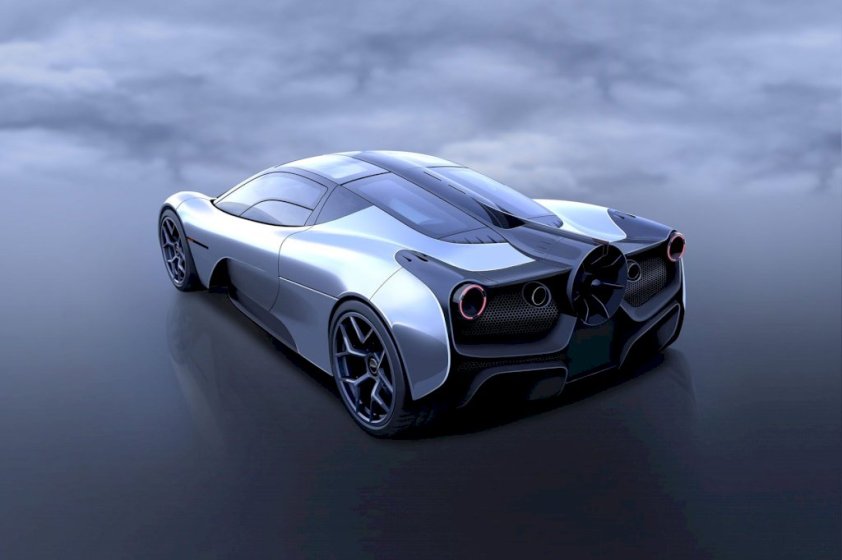 Gordon Murray has released the first renderings of his sequel-to-his-world-changing-McLaren-F1, and while it does indeed look like it has the potential to be the last great sports car, it still has a lot to live up to.Powering the new car, the T.50, will be the best engine in the world, a V12, displacing 3.9 litres and producing 650 horsepower. It will be built by famed engine builder Cosworth, and rev to 12,100 rpm.The styling is distinctly reminiscent of the 1990s McLaren F1, albeit slightly tweaked. Oh, and theres obviously now a huge fan protruding from its rear.Thats because the T.50 will also use aerodynamic technology based on fan car concepts from the past. The first car to use this tech was the Chaparral 2J, which had two snowmobile motors in the rear that would suck air out from under the car, sticking it to the pavement. The car was quickly banned from racing. The tech found itself in racing once more, however, in the Brabham BT46B Formula 1 car, which was also designed by Gordon Murray. Unfortunately, that car only raced once before team boss and future F1 chief executive Bernie Ecclestone shut down the project over concerns the upset from other teams could collapse the Formula One Constructors Association.The McLaren F1 was also supposed to have this fan tech, but Murray ran out of time to implement it. The T.50 will weigh just 2,160 pounds, much lighter than the 2,500-pound F1, so it will need all the help it can get from gravity and
Origin: Gordon Murray’s T.50 will use fans to vacuum the supercar to the road
 All about car