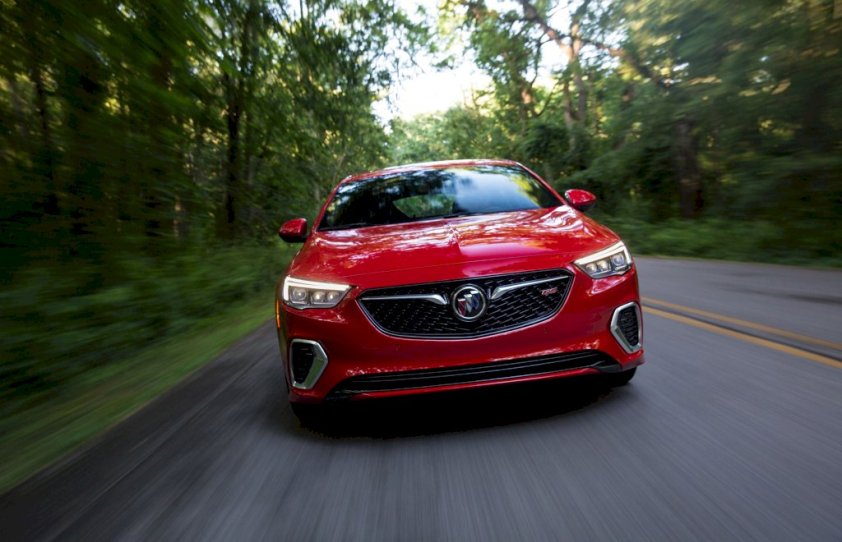
 2018 Buick Regal GS Buick will kill off its Regal sedan in Canada after 2020, making the brands product range crossovers only for model year 2021, a spokesperson told magazine Motor Authority.The four-door will say good-bye to the North American market, where crossovers made up almost 90 per cent of Buick sales this year, says Stuart Fowle of Buick and GMC communications, but will remain on sale in China, where demand for sedans is still strong.In Canada, Regal sales in 2019 are the highest theyve been since 2016, with about 747 units moved to-date.The mid-size LaCrosse left the Buick lineup earlier this year, and the Regals being axed will leave the brand with a range of En-named utilities, from the subcompact Encore to the full-size Enclave.The current-generation Buick Regal is built by German automaker Opel, which General Motors sold off in 2018, around the time of this gens debut. The two companies worked out an agreement where GM pays Opel to build the car for it.The 2020 Buick Regals sold in China recently refreshed by Opel will apparently continue to be built for GM by the German company. We wont be getting that updated car in Canada next year, though, just a continuation of the 2019
Origin: Buick will become a crossover-only brand in 2021, killing off Regal
brand:
General Motors could revive Hummer as electric SUV brand
 American automotive giant General Motors (GM) is considering a revival of the Hummer brand for a new line of premium electric SUVs and pick-up trucks, according to Reuters. The company is reportedly aiming to put a new range of large luxury EVs, codenamed BT1, into production at its Detroit-Hammtramck factory by the end of 2021. The first BT1 model, currently known as Project O, is said to be a pick-up for an as-yet-undetermined brand, with internal sources suggesting use of the Hummer name is “under consideration”. It will be followed by a hardcore performance version in 2022. Claimed to also be in development are an electric pick-up for GMC and an electric SUV for Cadillac. Both are set to arrive in 2023. GM is investing $7.7 billion (£5.9bn) into preparing its US factories for the shift to electrification over the next four years, with the Detroit-Hammtramck facility being upgraded at a cost of $3bn (£2.3bn) to produce electric trucks and vans. The large EVs will sit stop a new skateboard-style chassis, similar to that of start-up company Rivian, which combines motors and batteries for cheaper production costs. Around 80,000 units per year are expected to be produced. Regarding GM’s choice to develop premium EVs before more affordable models, Auto Forecast Solutions’ Sam Fiorani told Reuters: “It makes perfect sense to hit the high end of the market in order to generate some revenue that might actually turn a profit.” Such a move, he noted, has proved lucrative for Tesla, which launched with the low-volume Roadster before going on to rival BMW and Mercedes-Benz with the Model S. GM recently ended production of the Chevrolet Volt plug-in hybrid, citing a decline in demand for saloon models. Its replacement, the Bolt, is an electric hatchback that’s expected to cost its maker between $8000-$9000 per unit as a result of the augmented cost of EV production compared to that of conventionally powered cars. Production of the iconic Hummer H2 and smaller H3 ended in 2009, as GM eyed a return to profit following a high-profile bankruptcy announcement. The BT1 electric pick-up is likely to be priced to compete with the Rivian RS1 and could beat Tesla’s long-awaited truck to
Origin: General Motors could revive Hummer as electric SUV brand
Volvo launches Recharge brand for electrified cars
 Volvo will introduce a new Recharge brand for all of its full electric and plug-in hybrid cars, and has vowed to show buyers the average lifecycle carbon footprint of each new model as part of a bold set of plans to reduce its carbon emissions. The new Recharge line will be introduced with the Swedish firm’s first battery electric vehicle, the XC40 Recharge, which will be unveiled later today (Wednesday). That will also be the first model for which Volvo will disclose the average lifecycle carbon footprint – effectively the CO2 emissions the car will produce during its life with both manufacturing and usage taken into account. The Recharge label will be used on all new electrified models the firm releases from now on. Volvo says that it will use the brand to push sales of electrified cars, and that it will offer incentives to encourage plug-in hybrid drivers to use the full electric Pure mode as much as possible. Volvo has already revealed plans for half of the cars it sells by 2025 to be fully electric, and has now launched a wider climate plan with the aim to reduce the lifecycle carbon footprint per car by 40% from 2018 figures by the same date. The firm has also set a target of becoming an entirely climate-neutral company by 2040. Volvo has already pledged that every new car its introduces will feature an electrified powertrain. But it says that meeting its climate target will involve both pursuing “all-out electrification” of its vehicle line-up, and reducing carbon emissions from its manufacturing network, wider operations and supply chain. The firm is also aiming to increase both recycling and the reuse of materials. To achieve a 40% reduction of its per car CO2 footprint by 2025, Volvo has set goals for that date of reducing CO2 emissions from its global supply chain by 25%, reducing its own carbon emissions by 25% and using 25% recycled plastics in new cars. Volvo boss Hakan Samuelsson said that the firm was “transforming our company through concrete actions, not symbolic pledges.” He added: “We will address what we can control, which is both out operations and the tailpipe emissions of our cars. And we will address what we can influence, by calling on our suppliers and the energy sector to join us in aiming for a climate neutral future.” Volvo recently announced plans to merge its combustion engine programme with parent firm Geely, and then spin it off into a separate company. It says that will allow it to focus fully on electrified
Origin: Volvo launches Recharge brand for electrified cars
Volkswagen reveals new look for high-performance R brand
 Volkswagen has continued its rebranding efforts with a revised logo for its high-performance R sub-division. The German firm unveiled a new version of its VW roundel at the Frankfurt motor show as part of a company-wide rebranding effort. The new look is currently being rolled out across the UK. It has now introduced a new version of the R logo for its performance arm, which will appear on all of the sub-brand’s models. It will first be seen on the Atlas Cross Sport R-Line, which will be revealed shortly for the North American market. Volkswagen claims the new logo symbolises a fresh start for the R brand. Jost Capito, who heads up the division, said that R is “all about excitement and thrill” and that the firm is taking a “strategic and operative approach to working on great products and creating a unique customer experience.” The new logo was developed by Volkswagen’s in-house design team, with a focus on ensuring it would work in digital formats. It was designed to be “modern, distinct and sleek” and to show a “broader, more powerful impression” that “defined Volkswagen’s commitment to performance and exclusivity.” The Atlas Cross Sport will be revealed next week, following the concept version revealed at last year’s New York motor
Origin: Volkswagen reveals new look for high-performance R brand
Lotus reveals new logo as part of brand revamp
 The new insignia is the eight variation of the roundel to be used over the years. The initial design was used from 1948 to 1985, featuring the Lotus name and an emblem formed by the intertwined initials of Anthony Colin Bruce Chapman. The only exception was in 1968, when the firm tried a black-and-white version. A new roundel featuring bold overlapping lettering and no intertwined initials was introduced in 1986. The ‘ACBC’ symbol returned the following year, before the classic design was brought back in 1989. It then underwent minor revamps in 2009 and 2010. The new logo was unveiled at the same time as Lotus announced a deal with nearby Premier League football club Norwich City that will involve the car maker sponsoring the team’s academy
Origin: Lotus reveals new logo as part of brand revamp
Ranked: All the best car brand logos
 Think Ford was going to max out with the Shelby GT350 Mustang? Think again. A brand’s logo is its face and its signature. In a letter or word, design or crest, it acts as a visual representation of the objects it will be attached to. In the automotive world, brands go to great lengths to design badges that create an identity that will draw fans toward it even before they see the rest of the vehicle. This list represents the crème de la crème in automotive logo design. From the most storied to the most iconic to the most badass, here are the best 15 automotive logos, ranked.1. Alfa RomeoAlfa Romeo’s badge floats to the top because, like all great art, it tells a story but still holds some mystery. The red cross, a common medieval Christian symbol, is easy to explain; it represents Milan. The meaning of the human figure being consumed by a snake-dragon creature, on the other hand, is a little less straightforward. The image is known as the Visconti Serpent, another symbol of Milan. It used to be that the figure pictured was usually a baby or a Muslim man, which hardly seems appropriate for a modern international brand, but Alfa Romeo insists its logo tells a tale of birth, not death, with the figure emerging from the mouth of the snake as a new man. 2. ShelbyIf you had to get a car brand tattooed on your bicep, this would be the one to go with. It’s just cool, full-stop. 3. Mercedes-BenzThe Mercedes-Benz three-pointed star emblem is synonymous with luxury. Sure, the marketing dollars behind the logo have a lot to do with the way it makes people feel, but there’s still something incredibly sexy about the simple design. In 1926, the logo had a wreath around it and was often seen in colour, but once the brand converted to an all-silver design, it stuck.4. LamborghiniA powerful machine requires a powerful logo. Imagine Ferruccio Lamborghini had chosen a parrot instead of a raging bull? The Italian automaker had an infatuation with bullfighting, and not only used the ill-tempered animal to brand his company, but named many vehicles after the sport, including the Miura (a Spanish family with a long history in bullfighting); the Jarama (named after a famous bullfighting area in Spain); and the Aventador (a famous Spanish bull).5. Abarth Abarth, the official vehicle of Scorpios everywhere. It’s true, sort of, as founder Karl Alberto Arbarth chose his Zodiac sign (and, fortunately for him, the most badass of the dozen) as the mascot for his brand. The red, white and green bar across the top, meanwhile, is a cross-section of the Italian flag. 6. Ford A Ford logo on the grille of a 2018 Ford Explorer on display at the Pittsburgh Auto Show. Ford’s logo recognition is so strong, it even has a nickname based on it. The Blue Oval as we know it today can be traced back to 1903 and the Ford Model A, which bore the same ‘Ford’ font as the current logo and was designed by a friend of Henry Ford’s. The wording inside has changed over the years – the first logo read ‘Ford Motors Detroit Mich.’ – but the oval has been the border of choice since the get-go.7. TeslaYes, it’s a T, but did you know that the electric car logo has a deeper meaning than just the first letter of the brand’s name? Elon Musk offered this explanation on Twitter: “Similar to SpaceX, the T is like a cross section of an electric motor, just as the X is like a rocket trajectory.”8. PorscheHere’s one your word-of-the-day calendar may not have gotten to yet: inescutcheon, or a small shield within a larger shield. That’s what Porsche’s got going on in its badge, the coat of arms of its home town of Stuttgart set inside the coat of arms of the Free People’s State of Württemberg. Where Cadillac fails to restrain itself (Emboss! Emboss! Emboss!), Porsche nails the luxury vibe. 9. JaguarWhile Lamborghini chose a raging bull to represent its performance capability, in 1945, Jaguar opted to illustrate power and luxury in another way: a slinky jungle cat known for its grace, poise and strength. The brand’s first logo, an ‘SS’ for Swallow Sidecar Company, was tossed to the curb following the second world war for obvious political reasons. 10. IsuzuThis Japanese brand was first founded in 1916 and while its logo has been through a few iterations, its understated, minimalist essence has remained for over 40 years. In 1974, the automaker updated its all-caps logo to include two white pillars, though today, the wordmark is most commonly used. 11. Saab The most recognizable iteration of Saab’s logo – the navy circle and mythical red Griffin, a nod to its aviation history – could have passed for a beer logo from the 80s, but that’s what makes it so endearing. Before the auto arm of the brand went kaput, it was using a silver wordmark sans avian, but the Griffin lives. Saab is still very much active in the commercial air, naval, security and civil aerospace industries.12. VolkswagenNot that creative, but simple and iconic, like the brand. And about a million per
Origin: Ranked: All the best car brand logos
Mazda CEO confirms brand will launch an EV in 2020
 2019 Mazda CX-9Nick Tragianis / Driving Mazda has finally seen the electric-vehicle light. And it only took the threat of the European Union’s CO2 emissions penalties to bring it into focus. CEO Akira Marumoto disclosed in a QA interview with Automotive News Europe that Mazda does indeed have an EV in the oven, and it should be ready by 2020. “The first Mazda battery-electric vehicle will hit the market next year,” explained Marumoto in response to a question about how the company plans to reduce its fleet’s CO2 output. Not much else is known about the EV, other than it will be an entirely new vehicle with a Mazda-built electric powertrain. Mazda’s also planning changes to its Skyactiv-X engine, lowering CO2 output to 100 g/km, but that alone will not save it from the heavy hand of the European powers that enforce the Worldwide Harmonised Light Vehicle Test Procedure (WLTP) dictates. One major reason is that in Europe, Mazda’s best-selling vehicle is the CX-5, which has CO2 emissions in the 128 to 150 g/km range, well above the target of 114.9 g/km set by the WLTP. To lend support to the upcoming EV, Mazda has more goods in the electric oven, too. Marumoto says the brand will “introduce plug-in hybrid models from 2021 or 2022,” and that these, too, will have new powertrains. Brands that don’t make the CO2 target either pay fines or are forced to otherwise discontinue more-polluting models until the fleet average is brought in line; when asked which strategy Mazda’d take, the CEO said they’d have to wait and see. “We will have to balance the impact of possible CO2 penalties with our sales targets,” he said. “But we also have to consider the sustainability of our dealer
Origin: Mazda CEO confirms brand will launch an EV in 2020
VW brand to trim as many as 4,000 jobs amid digital overhaul
 A Volkswagen badge on a Golf GTI steering wheel.Nick Tragianis / Driving Volkswagen’s main car brand will let lapse as many as 4,000 general and administrative jobs while adding at least 2,000 IT positions over the next four years, avoiding layoffs at its German factories as it negotiates a major shift toward electrification and self-driving cars. The move, brokered with VW’s powerful unions, includes job guarantees through 2029, the manufacturer said Wednesday in a statement. The brand will rely on partial retirement and attrition to help reach targeted staff reductions as it culls models and focuses on new technologies that require fewer factory workers. With earlier job cuts, VW is on track with a plan announced in March to improve profit by 5.9 billion euros (US$6.7 billion) a year, the unit’s chief operating officer, Ralf Brandstaetter, said in the statement. “We are making the company fit for the digital age in a sustainable way.” The prospect of deeper cutbacks had alarmed VW’s union leaders as manufacturers wrestle with the transformation of sprawling industrial operations. App-based services like ride-sharing and car-sharing are already threatening the industry’s traditional business model of individual car ownership — a trend that may accelerate once self-driving vehicles reach critical mass — and electric cars require fewer parts and workers for assembly. The extended job guarantee is “an important signal,” VW works council chief Bernd Osterloh said in Wolfsburg, near the company’s headquarters. VW signed a broader labor pact in 2016 to cull 30,000 jobs worldwide, with Germany accounting for 23,000, to generate about 3 billion euros in annual savings. The VW car brand, which accounts for about half the group’s global deliveries, employs roughly 110,000 workers in Germany out of a global workforce of 663,000 across the Volkswagen group, the world’s largest automaker. The unit has been pushing to rein in bloated expenses to lift profitability that’s trailing rivals like PSA
Origin: VW brand to trim as many as 4,000 jobs amid digital overhaul
VW killing EV sports car platform, but may introduce new EV brand: report
 The VW I.D. Buzz Cargo ConceptHandout / VW Commercial Volkswagen is planning a lot of changes for the coming years, and they aren’t insignificant ones, either, according to a new report. Within 10 years, the Volkswagen group is planning on ditching a lot of the extra weight it pulls around, including a few vehicle platforms and brands, Automobile Magazine reports. Before it even got off the ground, VW is allegedly killing off Porsche’s proposed SPE electric sports car platform, and instead will work only with the three new architectures it’s already developed, the MEB, PPE and the J1, which underpins the Taycan. Even the upcoming electric Boxster and Cayman will have to adapt and use a converted MMB structure instead of its own new platform. While VW puts itself in a good position to create 70 new electric vehicles (EVs) by 2028, the future doesn’t look so bright for a few of the luxury brands under the company’s umbrella. Bentley will most likely get chopped or sold off, says Automobile, as almost no part of VW’s plans for the future includes massive W-12 luxury cars helmed by execs not keen on EV technology. Bugatti might also be gifted to Ferdinand Piech of Porsche, and Italdesign and Ducati could also be blown off soon, too. Lamborghini is the only brand that might get a second chance, the report says. VW, Audi and Porsche are likely to survive untouched. VW is also willing to take a risk on building a brand-new EV-only brand that would take on Tesla. According to VW boss Herbert Diess, “It would be a mistake not to address the increasingly volatile market with potentially game-changing new offerings. Trouble is, we already have a very full plate, and there is a limit to our spending power.” The plan would be to build EVs the size of the compact Up! with an electric range of up to 160 km for urban drivers, and to build in the ability to spawn up to 10 other body styles inside the brand, to be used as taxis and shuttle vans. So VW is making some big changes, but as Diess says, risks and opportunities live next door to each
Origin: VW killing EV sports car platform, but may introduce new EV brand: report
 All about car