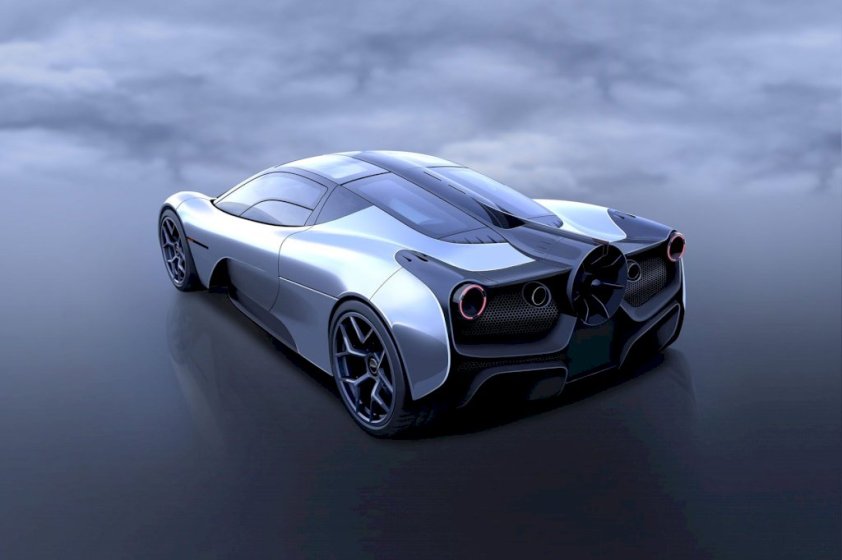
 Gordon Murray has released the first renderings of his sequel-to-his-world-changing-McLaren-F1, and while it does indeed look like it has the potential to be the last great sports car, it still has a lot to live up to.Powering the new car, the T.50, will be the best engine in the world, a V12, displacing 3.9 litres and producing 650 horsepower. It will be built by famed engine builder Cosworth, and rev to 12,100 rpm.The styling is distinctly reminiscent of the 1990s McLaren F1, albeit slightly tweaked. Oh, and theres obviously now a huge fan protruding from its rear.Thats because the T.50 will also use aerodynamic technology based on fan car concepts from the past. The first car to use this tech was the Chaparral 2J, which had two snowmobile motors in the rear that would suck air out from under the car, sticking it to the pavement. The car was quickly banned from racing. The tech found itself in racing once more, however, in the Brabham BT46B Formula 1 car, which was also designed by Gordon Murray. Unfortunately, that car only raced once before team boss and future F1 chief executive Bernie Ecclestone shut down the project over concerns the upset from other teams could collapse the Formula One Constructors Association.The McLaren F1 was also supposed to have this fan tech, but Murray ran out of time to implement it. The T.50 will weigh just 2,160 pounds, much lighter than the 2,500-pound F1, so it will need all the help it can get from gravity and
Origin: Gordon Murray’s T.50 will use fans to vacuum the supercar to the road
fans
Corvette courts Ferrari fans with a mid-engine sports car
 The mid-engine Corvette is finally coming.Handout / Chevrolet Barry Grussner has been a Corvette junkie since he was a high school kid in the 1960s. He fawned over the original two-seater until he was able to buy his first, a used 1962 model.Eight Corvettes later, Grussner is one of the first to have reserved the radically changed car that General Motors is showing off Thursday near Los Angeles and will start producing this summer.CEO Mary Barra will be at the event to unveil the first-ever Corvette with the engine built into the middle of the car, just behind the two seats.Its a design approach that the likes of Lamborghini and Ferrari have taken for years to better balance the weight of the car onto the wheels and improve handling. It also pushes the cabin forward and raises the back haunches, making the car look more like a cat thats ready to pounce.You get an engine in back like Porsches and Ferraris, said Grussner, 71, who owns a machine shop in the Detroit suburb of Wayne, Michigan. With a mid-engine, its going to be a great handling car, and if it looks like the sketches Ive seen, it will look great too.At a time when consumers are far more interested in SUVs and investors are keen to hear about carmakers plans to deploy futuristic robotaxis, an all-new Corvette seems so 1998. The market share for sports cars has been shrinking for several years. Yet GM is adding 400 workers and a second production shift at its plant in Bowling Green, Kentucky, in a big bet on booming demand for a re-imagined American icon.Its an audacious move. As Baby Boomers have gotten older, theyve been leaving sports cars for sport utility vehicles with more space and creature comforts. Corvette sales have fallen every year since 2014, including a 25-per-cent drop last year to less than 19,000 units. Sales are down another 10 per cent this year as GM prepares to bring out the newest-generation car.GMs biggest challenge may have less to do with appealing to existing owners than with getting a new generation of sports-car enthusiasts to take a look. To do that, Chevy will have to overcome less-than-ideal generalizations about who buys Corvettes.The hold-back for younger buyers with Corvette has not been the engine location. Its the image, said Eric Noble, president of The CarLab, a consulting firm in Orange, California. The image is some old white guy with a mustache whos on his third wife.Chevy is trying to appeal to first-time buyers with new technology features in the car, GM spokesman Chris Bonelli said, without elaborating on what new gadgets the new Corvette will offer.Plenty of Corvette die-hards are lining up for the car. Paul Stanford, who owns one of the largest Corvette dealerships in the U.S., said he has 170 people who have put down a couple thousand dollars to get on the waiting list and reserve one. He said GM is telling its dealers that they expect to be able to steal away some buyers of high-end European brands.People looking at these $250,000 mid-engine cars will look at this and see true value, said Stanford, whose Chevrolet store is in Dearborn, Michigan. Chevy is looking for a big opportunity with this car. Corvette buffs have been clamoring for a mid-engine sports car since GM first brought the model to life in 1953, said Kelly Ryan, president of the Corvette Club of America. While its controversial among front-engine fans, he thinks its the right move.This will be a giant step forward, Ryan said. Its about time. Ill buy one.With a starting price on the current model of $56,000 for the entry-level Stingray, Corvette has sold well in part by offering high performance for far less than European sports cars. But while the mid-engine configuration may improve handling, it also may make the car less appealing as a daily driver, CarLabs Noble said.Ryan said younger members are joining the Corvette Club and that he expects the new car to accelerate that generational shift. He sees the mid-engine debate as nothing compared with what the future holds.I figure in five years well see an electric Corvette, Ryan said. This may be the last major change to a Corvette that runs on gasoline.If Ryan is right, the die-hards will really have something to argue about
Origin: Corvette courts Ferrari fans with a mid-engine sports car
 All about car