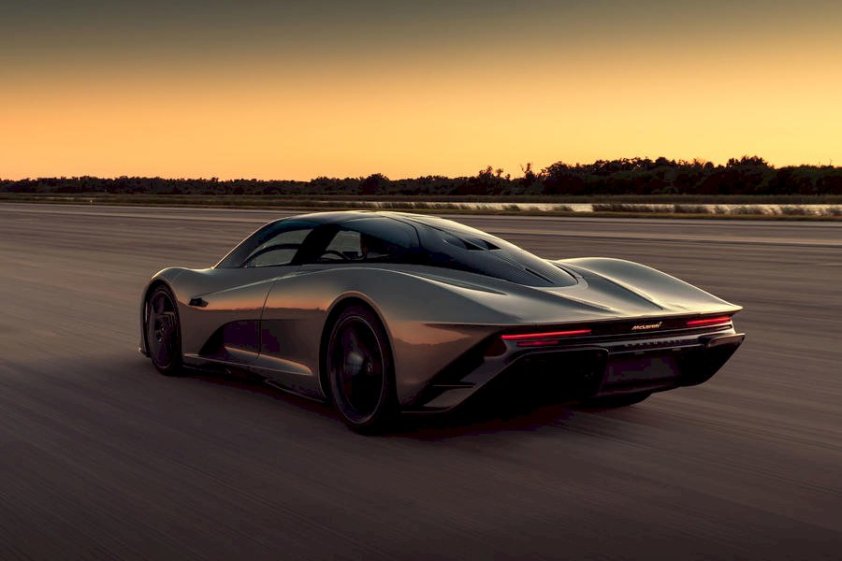
 The new McLaren Speedtail has concluded its final testing phase with a series of 250mph runs at the Kennedy Space Centre in Florida. A development prototype, named XP2, was taken to its top speed more than 30 times on the Johnny Bohmer Proving Ground’s three-mile runway, confirming its status as the fastest car McLaren has yet built. That title was originally held by the firm’s iconic F1 hypercar, which achieved a 231mph top speed following its launch in 1994. McLaren’s chief test driver Kenny Brack was at the wheel of XP2 for the high-speed runs, which followed previous tests at locations including Idiada in Spain and Papenburg in Germany. The company calls the £1.75m Speedtail “a showcase for the brand’s expertise in lightweight engineering”, and notes that it is more aerodynamically efficient than any of its previous models. The hypercar is McLaren’s first series-production hybrid model since the 789bhp P1, and its first three-seater since the F1. At 5137mm long, it is also the longest production car to come out of Woking. McLaren CEO Mike Flewitt said: “The Speedtail is a truly extraordinary car that epitomises McLaren’s pioneering spirit and perfectly illustrates our determination to continue to set new benchmarks for supercar and hypercar performance.” At its unveiling in 2018, McLaren said the Speedtail will be a true driver’s car. It has been designed as a ‘hyper-GT’, and is said to balance “a mature, stiff ride with comfort and speed”. Exact details of the Speedtail’s 1055bhp petrol-electric powertrain remain under wraps, but McLaren claims the battery pack has a power density of 5.2kW/kg, giving it “the best power-to-weight ratio of any automotive high-voltage battery system”. With testing now complete, the Speedtail has now officially entered production at McLaren’s Woking factory, with deliveries of the 106 cars already sold set to begin in February
Origin: New 2020 McLaren Speedtail hits 250mph in final tests
final
Swedish EV firm NEVS to sell final new Saab 9-3 this month
 The last new Saab 9-3 ever to be made will be auctioned off later this month to raise funds for research into zero-emissions travel. The almost-unused saloon was built in 2013. It will now be sold by National Electric Vehicle Sweden (NEVS), the EV manufacturer that acquired Saab’s assets upon the firm’s collapse in 2012. Proceeds will be donated to NEVS’ Sustainable Mobility Scholarship at Sweden’s University West. NEVS said: “The fund will be awarded to individuals making significant efforts to pave the way for future mobility solutions, ranging from electric car technologies and sharing economies to initiatives for self-driving cars.” The model up for auction is a 217bhp 2.0-litre petrol Aero Turbo saloon in silver, which, according to the company, was intended for crash test purposes and set aside from customer models. The car has been parked ever since, with around 40 recorded miles on the clock, making it the final new 9-3 to leave the Tröllhattan factory. Saab ceased production of the 9-3 in 2011 and planned to unveil an all-new model at the following year’s Paris motor show. It was to be a dramatically styled two-door coupé with a 200bhp 1.6-litre turbo engine supplied by BMW. The Swedish manufacturer’s collapse in 2012 put a stop to development of the new 9-3. Production of the final-shape model resumed under NEVS in 2013, with contribution from around 400 external suppliers, but ended just a year later, with only 420 units having left the factory. NEVS recently began production of the 9-3 EV, a 186-mile-range electric saloon based on the conventionally fuelled
Origin: Swedish EV firm NEVS to sell final new Saab 9-3 this month
Swedish EV firm NEVS to sell final Saab 9-3 this month
 The last new Saab 9-3 ever to be made will be auctioned off later this month to raise funds for research into zero-emissions travel. The almost unused saloon was built in 2013. It will now be sold by National Electric Vehicle Sweden (NEVS), the EV manufacturer that acquired Saab’s assets upon the latter’s collapse in 2012. Proceeds will be donated to the firm’s Sustainable Mobility Scholarship at Sweden’s University West. NEVS said: “The fund will be awarded to individuals making significant efforts to pave the way for future mobility solutions – ranging from electric car technologies and sharing economies to initiatives for self-driving cars.” The model up for auction is a 217bhp 2.0-litre petrol-powered Aero Turbo saloon in silver, which, according to the company, was intended for crash test purposes and set aside from customer models. The car has been parked ever since, with around 40 recorded miles on the clock, making it the last new 9-3 to leave the factory. Saab ceased production of the 9-3 in 2011, with plans to unveil an all-new model at the following year’s Paris motor show. It was to be a dramatically styled two-door coupe, with a 200bhp 1.6-litre turbocharged engine supplied by BMW. The company’s collapse in 2012 put a stop to development of the new 9-3, and production of the final-shape model continued under NEVS in 2013, with contribution from around 400 external suppliers. Production finally ended in 2014, with just 420 units having left the ex-Saab factory in Trollhättan, in the south of Sweden. In 2018, NEVS began production of the 9-3 EV, a 186-mile electric saloon based on the conventionally fuelled
Origin: Swedish EV firm NEVS to sell final Saab 9-3 this month
The final, brand-new Saab 9-3 ever built will be auctioned off
 Saab may have folded in 2012, ending an era of vehicles that were quirky and safe, but now, the final brand-new 9-3 sedan will be going up for auction later this year. According to Autocar, the 9-3 in question is a 2013 model-year car powered by a 217-horsepower, 2.0-litre turbocharged gasoline engine. It was supposed to be crash-tested, but somehow survived the concrete wall before the tests were conducted — meaning it only has 3.1 miles on the odometer. When National Electric Vehicle Sweden (NEVS) acquired Saab’s assets after their collapse in 2012, this 9-3 came along with it. The vehicle will be on display at the annual Saab Car Museum Festival celebrations in Trollhattän. Production of the 9-3 ceased in 2011, and there were plans to build a new-generation 9-3, as well as a BMW-powered two-door coupe, but neither materialized due to the company folding. Final production of all Saab models under NEVS stopped in 2014 with 420 units having been built, leaving the crash-test model we see here hidden away. According to a NEVS spokesperson, discussions are being made to determine if the profit from the sales will go toward a
Origin: The final, brand-new Saab 9-3 ever built will be auctioned off
Final Saab 9-3 to leave NEVS factory in Sweden
 The last new Saab 9-3 ever to be made will be auctioned in Sweden this year. The almost unused saloon was built in 2013. It will now be sold by National Electric Vehicle Sweden (NEVS), the EV manufacturer that acquired Saab’s assets upon the latter’s collapse in 2012. The model up for auction is a 217bhp 2.0-litre petrol-powered Aero Turbo saloon in silver, which, according to the company, was intended for crash test purposes and set aside from customer models. The car has been parked ever since, with just 3.1 recorded miles on the clock, making it the last new 9-3 to leave the factory. NEVS will display the 9-3 in Trollhattän this weekend during the town’s annual Saab Car Museum Festival celebrations, with the auction set to take place later this year. A company spokesman said discussions are underway to determine whether the proceeds from the sale will be donated to charity. Saab ceased production of the 9-3 in 2011, with plans to unveil an all-new model at the following year’s Paris motor show. It was to be a dramatically styled two-door coupe, with a 200bhp 1.6-litre turbocharged engine supplied by BMW. The company’s collapse in 2012 put a stop to development of the new 9-3, and production of the final-shape model continued under NEVS in 2013, with contribution from around 400 external suppliers. Production finally ended in 2014, with just 420 units having left the ex-Saab factory in Trollhättan, in the south of Sweden. In 2018, NEVS began production of the 9-3 EV, a 186-mile electric saloon based on the conventionally fuelled
Origin: Final Saab 9-3 to leave NEVS factory in Sweden
Ford wraps the race GT in new Le Mans liveries for its final season
 The factory Ford Le Mans GT team for the 2019 seasonFord Four years ago, Ford roared back to Le Mans with its factory GT program, intent on marking the golden anniversary of sending Ferrari to bed without their supper. They did so in fine style, winning the 2016 event and standing on the podium where so many greats have stood before. Ford will close another great chapter at Le Mans for the factory team, choosing to bow out of the race after the 2019 soirée. To mark the occasion, Ford has revealed a special series of “Celebration Liveries” for the Ford Chip Ganassi Racing Ford GTs ahead of the 2019 Le Mans 24 Hours. Each of the four factory Ford GTs will bear a livery that celebrates the success of the manufacturer at Le Mans, both in the present day and during the 1960s when they kicked Ferrari around like an unloved rag doll. The #66 Ford GT raced by Mücke, Pla and Johnson has a black livery that echoes the Ford GT40 of Bruce McLaren and Chris Amon, the one that won Le Mans in 1966. The Ford GT40 piloted by Dan Gurney and A.J. Foyt to victory at Le Mans in ‘67 is evoked in the #67 livery, a whip which will be handled by the trio of Priaulx, Tincknell and Bomarito. Marking more recent history is the #68 car, racing in the same colours as when it won Le Mans in 2016. At the wheel this year are Müller, Hand and Bourdais. With all this success, why not add a fourth car? The #69 Ford GT of Dixon, Briscoe and Westbrook takes its design cues from the Ford GT40 that came second to the black car during Ford’s 1-2-3 finish in 1966. An outfit called Keating Motorsports is fielding what’s referred to as a customer team this year as well. It’ll bear #85 and race in the GTE Am class. It’ll use the same livery design as the four factory Fords but in the colours of its title sponsor, Wynn’s. The Ford GTs will be on track in their new celebration liveries this Sunday (June 2nd) for the official Le Mans Test. Fans will be able to follow the 24-hour race on June 15 to 16 from inside the cockpit of the factory Ford GTs via
Origin: Ford wraps the race GT in new Le Mans liveries for its final season
 All about car