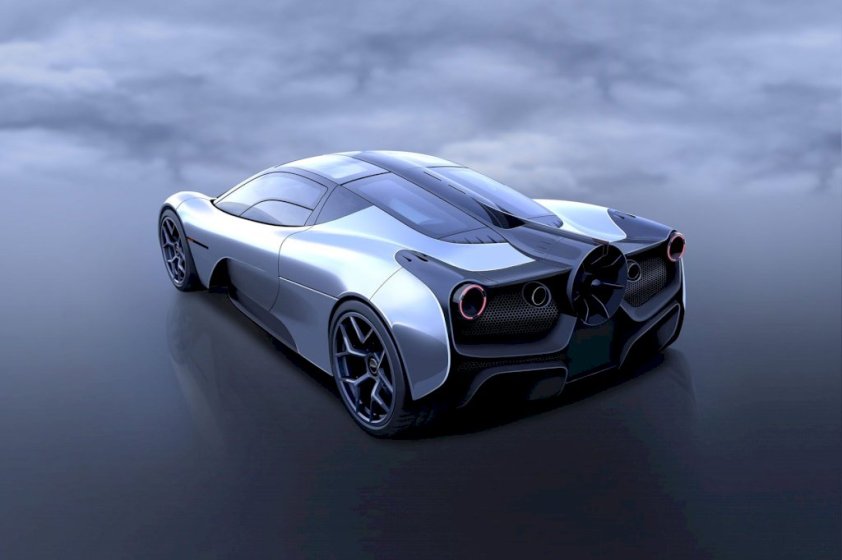
 Gordon Murray has released the first renderings of his sequel-to-his-world-changing-McLaren-F1, and while it does indeed look like it has the potential to be the last great sports car, it still has a lot to live up to.Powering the new car, the T.50, will be the best engine in the world, a V12, displacing 3.9 litres and producing 650 horsepower. It will be built by famed engine builder Cosworth, and rev to 12,100 rpm.The styling is distinctly reminiscent of the 1990s McLaren F1, albeit slightly tweaked. Oh, and theres obviously now a huge fan protruding from its rear.Thats because the T.50 will also use aerodynamic technology based on fan car concepts from the past. The first car to use this tech was the Chaparral 2J, which had two snowmobile motors in the rear that would suck air out from under the car, sticking it to the pavement. The car was quickly banned from racing. The tech found itself in racing once more, however, in the Brabham BT46B Formula 1 car, which was also designed by Gordon Murray. Unfortunately, that car only raced once before team boss and future F1 chief executive Bernie Ecclestone shut down the project over concerns the upset from other teams could collapse the Formula One Constructors Association.The McLaren F1 was also supposed to have this fan tech, but Murray ran out of time to implement it. The T.50 will weigh just 2,160 pounds, much lighter than the 2,500-pound F1, so it will need all the help it can get from gravity and
Origin: Gordon Murray’s T.50 will use fans to vacuum the supercar to the road
Gordon
Gordon Murray’s new car is like a McLaren F1 but more aerodynamic, lighter, better
 Gordan Murray Automotive (GMA) has more fully revealed its plans for its analog supercar, a machine that’s rather apparently the spiritual successor to the McLaren F1 in everything but name. GMA was started just two years ago in 2017, but as you might’ve guessed, it’s headed by automotive genius Gordan Murray. He’s most famously known for designing the original McLaren F1 supercar of the ’90s, but says this new coupe will be his magnum opus, and the perfect way to mark the 50 years he’s spent in the motorsports engineering business. It’s called the T.50, and despite its impressive specifications, this will be a proper old-school supercar. According to Murray, the T.50 will be the most aerodynamically advanced supercar on the road, borrowing technology from vehicles like the Brabham fan car, and of course the F1. Taken altogether, those components will make it the purest, lightest, most driver-focused supercar ever, he says. The T.50 will weigh only 980 kg, which is a couple hundred kilograms less than the F1. Powering the mighty supercar will be a 3.9-litre V12 which produces only 650 horsepower, which seems a bit weak compared to the big numbers we’re used to with today’s supercars. In fact, that’s only 23 horsepower more than the original F1 made over 20 years ago, but with the weight deficit, there should still be some considerable performance on the table. The engine will be mid-mounted, and coupled to a manual gearbox, with power going to the rear wheels only. As advanced as the car is, from the profile we can see several design elements carried over from the original F1, which is a testament to just what a revolution that vehicle was. Of course, just because it’s a little old-school doesn’t mean the car is going to be cheap. In fact, the price is an eye-watering 2 million pounds ($3.4 million), and only 100 will be built. Deliveries are expected to start in early
Origin: Gordon Murray’s new car is like a McLaren F1 but more aerodynamic, lighter, better
Exclusive: Gordon Murray tells Autocar about his 2022 hypercar
 As Gordon Murray lays out preliminary details of his 2022 T.50 hypercar, we speak to the father of the McLaren F1 to find out why he’s not obsessed with lap records, how the model will achieve segment-leading downforce figures and why it will be better than 1994’s fastest car in every way. How do you relate the T.50 to the McLaren F1 you designed? “It’s fair to call T.50 today’s equivalent of the F1. That was certainly our intention. Of course, it’s very different because the materials and technologies available today are so much better than they were. I look at the toolbox we’ve got at our disposal now and it excites me more than ever.” Does your different approach with the T.50 mean you don’t think much of current hypercars? “Not true. I’ve driven them all and many are brilliant. Most are amazingly capable. But they’re nearly all heavy, which is something you can disguise at times but which really tells when you’re talking driver involvement. You simply feel the weight. Heavy cars don’t get the hairs on the back of your neck rising the way a powerful, ultra-lightweight car does.” Why are you determined not to chase lap records and performance figures with the T.50? “I just don’t see the point. F1 was quick and T.50 will be quicker. In any case, you’re on a hiding to nothing. Pick some extraordinary top speed, design your car to attain it, and soon someone will come along and beat it – because it’s all he wants to do. Building your car to chase targets compromises it in other ways and we’re trying to build an uncompromised car.” You talk a lot about the disappearance of clean and pure styling. What’s that about? “Modern supercar styling can be pretty ugly and the excuse is that the car has been ‘styled by the wind tunnel’. I think that’s cobblers. It shouldn’t be true. With our fan providing T.50’s downforce, we can give it ideal proportions and clean lines.” And the T.50’s styling extends to the engine bay? “Very much so. We did it with F1 and we’re doing it better this time. We won’t just have a big composite panel that looks a bit like an engine, as others do. You’ll be able to see our engineering. We’ve even designed the engine with internal galleries for the pipes and wires so you’ll see beautiful cam covers, inlet trumpets and exhausts. It’ll look like engines are supposed to look.” The F1 had a gold-lined engine bay. Will you do that again? “It’s possible. If gold is still the best medium for reflecting heat when we get to build our cars in 2022, we’ll probably use it.” Why not make an all-electric hypercar? “Just about the most ridiculous thing you could do at present is make an electric supercar. With batteries in their current state, you’d end up with something that weighed two tonnes, would go well in a straight line for a while, but wouldn’t corner because of the weight, and wouldn’t have much range. Our new car is the opposite of an electric supercar in just about every
Origin: Exclusive: Gordon Murray tells Autocar about his 2022 hypercar
 All about car