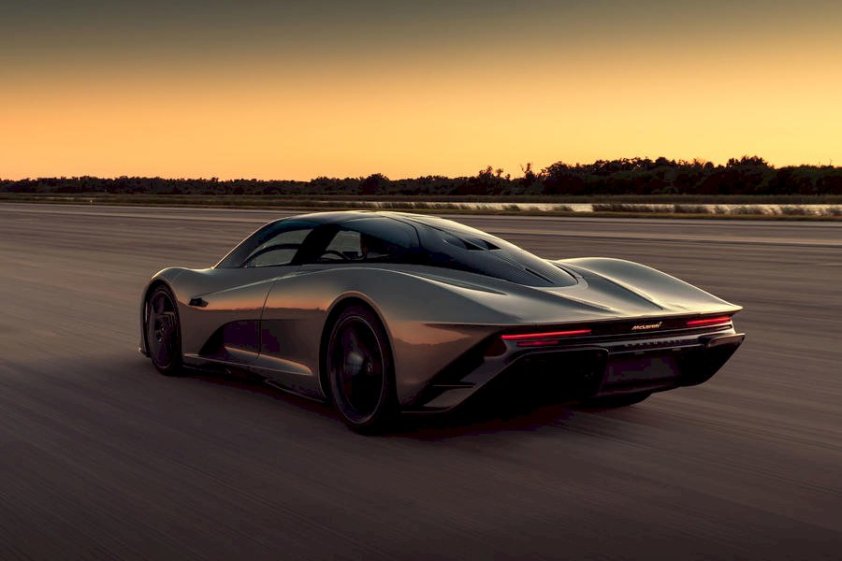
 The new McLaren Speedtail has concluded its final testing phase with a series of 250mph runs at the Kennedy Space Centre in Florida. A development prototype, named XP2, was taken to its top speed more than 30 times on the Johnny Bohmer Proving Ground’s three-mile runway, confirming its status as the fastest car McLaren has yet built. That title was originally held by the firm’s iconic F1 hypercar, which achieved a 231mph top speed following its launch in 1994. McLaren’s chief test driver Kenny Brack was at the wheel of XP2 for the high-speed runs, which followed previous tests at locations including Idiada in Spain and Papenburg in Germany. The company calls the £1.75m Speedtail “a showcase for the brand’s expertise in lightweight engineering”, and notes that it is more aerodynamically efficient than any of its previous models. The hypercar is McLaren’s first series-production hybrid model since the 789bhp P1, and its first three-seater since the F1. At 5137mm long, it is also the longest production car to come out of Woking. McLaren CEO Mike Flewitt said: “The Speedtail is a truly extraordinary car that epitomises McLaren’s pioneering spirit and perfectly illustrates our determination to continue to set new benchmarks for supercar and hypercar performance.” At its unveiling in 2018, McLaren said the Speedtail will be a true driver’s car. It has been designed as a ‘hyper-GT’, and is said to balance “a mature, stiff ride with comfort and speed”. Exact details of the Speedtail’s 1055bhp petrol-electric powertrain remain under wraps, but McLaren claims the battery pack has a power density of 5.2kW/kg, giving it “the best power-to-weight ratio of any automotive high-voltage battery system”. With testing now complete, the Speedtail has now officially entered production at McLaren’s Woking factory, with deliveries of the 106 cars already sold set to begin in February
Origin: New 2020 McLaren Speedtail hits 250mph in final tests
McLaren
McLaren releases road-going version of its GT4 race car, the 620R
 McLaren has revealed itll market a road-going version of its 570S GT4 race car which itself is a race version of its street cars called the 620R.Powered by the same 3.8-litre twin-turbocharged V8 engine as the GT4, the 620R makes 610 horsepower and 457 lb.-ft. of torque, which helps it get up to 100 km/h in just 2.9 seconds, then on to a top speed of 322 km/h.That power is sent to the rear wheels via a seven-speed gearbox, which is not borrowed from the race car.What is borrowed from the race car is the aerodynamics, chief among which is the rear wing which helps develop 185 kilograms of down force at 250 km/h. That stickiness is only aided by real slick tires, which offer an eight-per-cent larger contact patch. The entire car has been lightened as well a total 1,282 kilograms dry means its 31 kilograms lighter than the standard 570S. Carbon-fibre racing seats with five-point harnesses helped with that weight loss, as did the lightweight brakes with carbon-ceramic discs.Only 350 examples of the special-edition vehicle will be built, in three exclusive colours: McLaren Orange, Silica White and Onyx Black with McLaren racing livery. A Senna GTR livery will also be available. If you want different colours, MSO will be happy to oblige to your wildest imaginations. Deliveries will start February 2020. The price?
Origin: McLaren releases road-going version of its GT4 race car, the 620R
McLaren: no-go on SUVs, but yes to hybrids that do 96 km/h in 2.3 seconds
 McLaren GT McLaren bosses say an SUV is (still) out of the question, but note there will be room in the lineup for new technologies, like hybrid hypercars capable of zero-to-96-km/h times under two-and-a-half seconds.When Car and Driver recently prodded him on the prospect of building an SUV, McLaren Automotive CEO Mike Flewitt says trucks are still a non-starter for the British brand.Why would we? he says. We dont have to.Wed never get a return on it, Flewitt says. The cost of designing a brand-new platform would cost well over $1 billion, and besides that, were all getting sick of thoroughbred supercar manufacturers building SUVs just to make a profit.Instead of trying to fit more people in the back of its vehicles, McLaren is trying to fit more power, and thats why there will definitely be another hybrid model, as well as a pure EV, although it is less keen on those. Flewitt says current batteries are too heavy, too expensive and not dense enough to meet the brands standards.As for the hybrid model, its already in the works. Riding on a next-generation platform set to be unveiled in the spring of 2020, the vehicle will rock a hybrid powertrain with all-wheel-drive.The target zero-to-60-mph (96 km/h) time is in the realm of 2.3 seconds, since launches will be aided by an electric front axle. The model will be the first of an eventual all-hybrid lineup, which will gradually subsume the gas-only car range over three or four
Origin: McLaren: no-go on SUVs, but yes to hybrids that do 96 km/h in 2.3 seconds
With 804 hp and no roof or windshield, the Elva has Big McLaren Energy
 McLaren Automotive has released a two-seat roadster fitted with a turbo V8, an interesting new Active Air Management System — and not a single window. The McLaren Elva gets its name from the bygone sports and racing car manufacturer of the same name from the U.K., which McLaren collaborated with in the 1960s to produce a customer version of the M1A. The new Elva builds on its vintage predecessor’s open-top configuration with an ultra-modern design fitting of McLaren’s current lineup. Most notable is the car’s lack of glass of any kind (save for on the control screens) or a roof. That, along with ample use of carbon fibre throughout the shell, monocoque, bodywork, interior and more. Power is generated by a twin-turbo V8 from the same family as that in the Senna and Senna GTR. In the Elva, it’s rated at 804 horsepower and 590 lb-ft. of torque, which will compel the roadster from zero to 100 km/h in under three seconds. Zero to 200 km/h comes in just 6.7 seconds, beating the Senna’s time by 0.1 of a second. Aesthetically, the Elva has Big McLaren Energy, with rolling, muscular lines and no windscreen, roof, or windows of any kind cluttering up the top end. In place of the windshield, McLaren’s new Active Air Management system deploys automatically at anything greater than “urban speeds” to move air “through the nose of the Elva to come out of the front clamshell at high velocity ahead of the occupants before being directed up over the cockpit to create a relative ‘bubble’ of calm.”An actual physical windscreen is available as an option. McLaren plans to make just 399 of the open-top roadsters, with pricing at US$1.69 million for the base
Origin: With 804 hp and no roof or windshield, the Elva has Big McLaren Energy
The McLaren GT is all about the trunk
 NICE, France McLaren calls this car their GT. Gran Turismo in official parlance. Gentlemans tourer in colloquial English. Pace with grace in specific intent.But one never does escape genealogy, does one, carbon fibre tubs as telling in sports cars as DNA is in humans. And McLaren is a Formula One-cum-supercar company so, despite having 570 litres of cargo capacity a fact much boasted about by the companys public relations staff, by the way this GT is still, at heart, a supercar.That means that, despite having carved out enough space for a small golf bag, the GTs turbocharged engine is still behind the driver, its chassis is still a carbon fibre MonoCell and its oh-so-powerful brakes are still ginormous carbon ceramic discs fitted with massive six-pot calipers.In other words, its a McLaren. That means a screaming, twice-turbocharged V8. Oh, it is subdued in its Comfort mode, Paul Chadderton, McLarens global product communications spokesperson again taking great pains to point out the GTs adjustable exhaust system that allows, he says or, more accurately, implies the GT to do a fair impression of a Camry. I dont be thinking so! Oh, the 4.0-litre twin-turbocharged V8 pumps may be down a couple of ponies on the 720S but it is still a raucous, all-hands-on-deck supercar. One hundred kilometres an hour flashes by in an incredibly rapid 3.2 seconds, 200 klicks in just 5.8 seconds more and, were my attitude towards French jurisprudence just a little more cavalier, I could have floored the GT to the dark side of 325 km/h. Its a McLaren, for gosh sakes, and just because the turbocharging has been turned down a tick (partially compensated for by having the compression ratio raised to 9.4:1), its 612 horsepower and 465 pound-feet of torque only have to power but 1,538 kilograms. Chaddertons admonishments notwithstanding, the GT is just plain super, just the thing when the first hole is still some 20 klicks away and your tee time is in ten minutes.And dont worry that youre not going to make it because the road is snaky. Again, though this be the touring McLaren, it rides on an all-but-identical MonoCell II carbon-fibre tub that supports the entire Sport Series of McLaren road rockets. As for the changes that render it all but identical, the T (for Touring) version of the Monocell II simply gains a little rear upper superstructure that houses the new rear cargo area that separates the GT from, well, the rest of Wokings lineup. For all intents and purposes, the GT is simply a slightly-softened Sport Series McLaren (which nobody is decrying as anything less than super). Torsional rigidity is identical, the centre of gravity is just a tad higher and, because the engine is in exactly the same place, mass distribution remains very well centralized.That means, from the vantage of the super twisty mountain roads above Nice, that the GT is still either a pretty darn super car or has learned to tour very rapidly indeed. Chadderton says that the suspension still a cross-linked Proactive Chassis Control system has been softened. And perhaps in the Proactive Damping Control systems Comfort mode there is a greater degree of civility to the ride. But, toggled into Sport or Track mode and crushing the optional carbon ceramic discs going into yet another hairpin, it is preciously difficult to see where touring ends and super begins. Roll is all but absent, the hydraulic steering precise and the front 225/30ZR20 Pirelli PZeros grip French macadam like a Trump handshake on, well, a French president. In other words, its a McLaren supercar. What is different is that the GT boasts some 420 L of cargo space in the rear trunk (the rest, amounting to the aforementioned 570 L total, is in the de-rigueur-for-a-supercar small front cubbyhole). For some context here, both the 570 L total and even just the rear 420 L capacity is more than a Mercedes S-Class Coupe (400 L) or C-Class sedan (357 L). Thats enough for one bespoke-for-the-GT golf bag and a couple of roll-ons. Theres also a neat little net thingie so your laptop doesnt get heaved into the windows when youre pulling 1.0 g through French hairpins. McLaren even cools the cargo space it is sitting right above a very hot exhaust system, after all with ducting and heat reflection material so that your Titleists dont get spongy.That said, all this practically seems a little exaggerated. Said large trunk space again, 420L in a car with its engine aft of the seats is extremely oddly shaped and its storage capacity not nearly as commodious as the numbers might indicate. Indeed, despite the GTs trunk being technically larger than the aforementioned S-Class Coupe, theres no way in H-E-double-hockey-sticks that you can pack as much stuff back there.while McLaren has
Origin: The McLaren GT is all about the trunk
Ferrari unleashes new F8 Spider as McLaren 720S Spider rival
 Ferrari has revealed the F8 Spider as the drop-top version of its new V8-powered Tributo supercar. Described as “less extreme than the 488 Pista Spider but sportier than the 488 Spider” which it replaces, the F8 Spider gets the same 710bhp version of Ferrari’s 3.9-litre V8 engine as the F8 Tributo, meaning the same power output as the limited-run 488 Pista and the car’s biggest rival, the McLaren 720S Spider. The twin-turbocharged engine helps propel the F8 Spider from 0-62mph time in 2.9sec (0.1sec faster than the 488 Spider), 0-124mph in 8.2sec and a top speed of 211mph. The Ferrari’s top speed is just 1mph shy of its Woking rival. The V8 engine produces 568lb ft of torque peaking at 3,250rpm in the F8 Spider. Along with its extra power over the 488 Spider, it is also 20kg lighter at 1400kg. To help achieve the power upgrade over the 488 Spider, the new intake line is derived from the 488 Challenger track car. The air intakes have moved from the flanks to the rear on either side of the blown spoiler, which ensures greater air flow to the engine, says Ferrari. The F8 Spider retains the retractable hard top synonymous with Ferrari Spiders. The design compared to the F8 Tributo shifts the line between the body and roof from its conventional position at the beltline to above the B-pillar. The roof top is more compact than the 488 Spider and so can be divided into two parts and stowed on top of the engine. The top takes 14 seconds to deploy at speeds up to 28mph. Ferrari said that the F8 Spider’s performance is now accessible to more drivers “thanks to vehicle dynamics systems that make driving on the limit easier”. Based on previous generations’ pricing, the F8 Spider will cost around £25,000 more than the £203,476 F8 Tributo when it arrives on roads later this
Origin: Ferrari unleashes new F8 Spider as McLaren 720S Spider rival
New McLaren GT Special Operations showcase heading to Pebble Beach
 McLaren has unveiled a series of personalisation options open to buyers of its new GT through its in-house Special Operations division. The McLaren GT by MSO will make its public debut at this weekend’s Pebble Beach Concours d’Elegance. It showcases a range of interior and exterior styling tweaks said to be inspired by iconic British architecture. The model is painted in a newly developed shade of silver that’s exclusive to MSO, with the door skirts, front splitter, wing mirrors, brake calipers, rear bumper and diffuser finished in the division’s graphite grey. Also included is the MSO Bright Pack, which comprises a polished titanium exhaust tip, black diamond-cut alloy wheels and chrome window surrounds. Inside, the seatbacks, sunvisors, door cards and armrest are stitched in a pattern that pays homage to the geometric canopy design of the British Museum in London. The seats are trimmed in white leather, with elements of grey leather throughout the interior continuing the exterior’s design theme. Additional interior features unique to the model include MSO-branded headrests and sills, silver-infused carbonfibre shift paddles and bespoke floormats. The GT by MSO also shows off the optional electrochromic sunroof, which can turn opaque in high-intensity sunlight and shield the car’s occupants from glare. MSO hasn’t modified the GT’s twin-turbocharged 4.0-litre V8 engine, meaning the special edition model can accelerate from 0-62mph in 3.2sec and on to a top speed of 203mph. Ansar Ali, managing director of McLaren Special Operations, said: “We believe that the McLaren GT has class-leading elegance and sophistication and is the perfect car to further personalise, whether it be through an MSO Defined or MSO Bespoke option or, alternatively, a unique, customer-inspired design that MSO delivers a stunning interpretation of.” MSO unveiled a one-off reworking of McLaren’s new 720S Spider at this year’s Geneva motor show. As well as a unique blue-grey colour scheme, the 202mph roadster featured a carbonfibre tonneau cover, a sports exhaust and Alcantara interior trim. Costs for MSO’s range of bespoke GT upgrades are yet to be detailed, but deliveries of the standard model are scheduled to begin this autumn, with prices starting from
Origin: New McLaren GT Special Operations showcase heading to Pebble Beach
Exclusive: McLaren to launch extreme open-cockpit speedster
 McLaren is developing a two-seat open-cockpit speedster that will focus on providing exhilarating on-road driving and become the sixth model in its Ultimate Series, Autocar can exclusively reveal. According to a source aware of the car, the new limited-run machine will sit alongside the track-focused Senna and the 250mph Speedtail hyper-GT at the top of McLaren’s range. Whereas the Senna has been designed as the ultimate road-legal track car and the Speedtail developed around high-speed aerodynamic efficiency, the new speedster has reportedly been conceived for road-driving pleasure. It will apparently highlight the more emotional, fun side to McLaren – albeit while retaining the high-performance, high-tech traits for which the Woking firm is known. The as-yet-unnamed machine will be the first pure open road car McLaren has made, with styling that will reportedly evoke open-top sports prototype racers. That will pitch it into competition with Ferrari’s recently revealed Monza SP1 and SP2 speedster models. The speedster is claimed to offer a more ‘fluid’ interpretation of McLaren’s design language than the firm’s other models, with prominent use of flowing, elegant lines. Our source has been told the interior design will closely match that of the exterior and is set to feature low-profile dihedral ‘butterfly’ doors. The flowing styling will contrast with the aerodynamically focused Senna and reflects the fact that the new car is being developed primarily for use on the road, with the intention to maximise the ‘pure pleasure of driving’. It is being honed to deliver extremely agile handling while giving high levels of driver response. Our source has been told that it will offer astonishing levels of feedback. That driving experience, combined with the open cockpit, is understood to offer a greater connection between the driver and the environment around them. Power is tipped to come from McLaren’s 4.0-litre V8 twin-turbocharged petrol engine and, unlike the 1036bhp Speedtail, won’t include any electrification or other hybrid technology. The output for the car is not yet known, although the focus on road driving pleasure suggests it will be slightly reduced from the 789bhp of the Senna. However, as part of McLaren’s Ultimate Series line-up, it is still likely to be elevated from other models in the firm’s range. As is usual with McLaren, the power will be driven through the rear wheels only, likely through a dual-clutch automatic gearbox. The new speedster is tipped to weigh less than the 1198kg Senna, making it one of the lightest road cars the firm has ever built. This is achieved by both the lack of a roof and, as is customary for McLaren, extensive use of carbonfibre. The open-top machine will be a strictly limited-run model, with volume thought to be restricted to fewer than the 500 examples of the Senna that the company has produced. A price of around £1.5 million has been suggested, similar to the cost of the Monza SP1 and SP2. A reveal or launch date for the new model has not been determined yet, although it is likely to be produced after the 106 examples of the Speedtail. Production of that machine is due to begin in late 2019, after the final examples of the Senna GTR, which would suggest cars will start to be built in late 2020 or early 2021. McLaren models have traditionally been split into three series: Sport, Super and the range-topping Ultimate cars, although the forthcoming new grand tourer will launch a fourth. The Ultimate Series has its roots in the firm’s seminal road car, the F1, and was launched with the P1 plug-in hybrid supercar in 2013. When asked to confirm the project, a McLaren spokesperson declined to discuss the new car, saying: “Our usual position in respect of speculation about possible future models is not to comment and that’s the case
Origin: Exclusive: McLaren to launch extreme open-cockpit speedster
Exclusive: McLaren to launch elegant open-cockpit speedster
 McLaren is developing a two-seat open-cockpit speedster that will focus on providing exhilarating on-road driving and become the sixth model in its Ultimate Series, Autocar can exclusively reveal. According to a source aware of the car, the new limited-run machine will sit alongside the track-focused Senna and the 250mph Speedtail hyper-GT at the top of McLaren’s range. Whereas the Senna has been designed as the ultimate road-legal track car and the Speedtail developed around high-speed aerodynamic efficiency, the new speedster has reportedly been conceived for road-driving pleasure. It will apparently highlight the more emotional, fun side to McLaren – albeit while retaining the high-performance, high-tech traits for which the Woking firm is known. The as-yet-unnamed machine will be the first pure open road car McLaren has made, with styling that will reportedly evoke open-top sports prototype racers. That will pitch it into competition with Ferrari’s recently revealed Monza SP1 and SP2 speedster models. The speedster is claimed to offer a more ‘fluid’ interpretation of McLaren’s design language than the firm’s other models, with prominent use of flowing, elegant lines. Our source has been told the interior design will closely match that of the exterior and is set to feature low-profile dihedral ‘butterfly’ doors. The flowing styling will contrast with the aerodynamically focused Senna and reflects the fact that the new car is being developed primarily for use on the road, with the intention to maximise the ‘pure pleasure of driving’. It is being honed to deliver extremely agile handling while giving high levels of driver response. Our source has been told that it will offer astonishing levels of feedback. That driving experience, combined with the open cockpit, is understood to offer a greater connection between the driver and the environment around them. Power is tipped to come from McLaren’s 4.0-litre V8 twin-turbocharged petrol engine and, unlike the 1036bhp Speedtail, won’t include any electrification or other hybrid technology. The output for the car is not yet known, although the focus on road driving pleasure suggests it will be slightly reduced from the 789bhp of the Senna. However, as part of McLaren’s Ultimate Series line-up, it is still likely to be elevated from other models in the firm’s range. As is usual with McLaren, the power will be driven through the rear wheels only, likely through a dual-clutch automatic gearbox. The new speedster is tipped to weigh less than the 1198kg Senna, making it one of the lightest road cars the firm has ever built. This is achieved by both the lack of a roof and, as is customary for McLaren, extensive use of carbonfibre. The open-top machine will be a strictly limited-run model, with volume thought to be restricted to fewer than the 500 examples of the Senna that the company has produced. A price of around £1.5 million has been suggested, similar to the cost of the Monza SP1 and SP2. A reveal or launch date for the new model has not been determined yet, although it is likely to be produced after the 106 examples of the Speedtail. Production of that machine is due to begin in late 2019, after the final examples of the Senna GTR, which would suggest cars will start to be built in late 2020 or early 2021. McLaren models have traditionally been split into three series: Sport, Super and the range-topping Ultimate cars, although the forthcoming new grand tourer will launch a fourth. The Ultimate Series has its roots in the firm’s seminal road car, the F1, and was launched with the P1 plug-in hybrid supercar in 2013. When asked to confirm the project, a McLaren spokesperson declined to discuss the new car, saying: “Our usual position in respect of speculation about possible future models is not to comment and that’s the case
Origin: Exclusive: McLaren to launch elegant open-cockpit speedster
RM Sothebys to auction super-rare McLaren F1 for US$21M
 The McLaren F1 is a special piece of machinery. For starters, the British supercar manufacturer only ever made 106 of them, 64 of which were given the gift of being legally allowed to drive on public roads. This example, chassis 018, which is set to soon cross the RM Sotheby’s auction block, is even more special. It’s one of two to have been called back to the factory following the F1’s win at Le Mans in 1995 and fitted with a GTR racing engine and High-Downforce Kit (HDK).The 1994 McLaren F1 LM-Specification’s V12 has been stripped of its restrictors, allowing it to push out another 53 horses to bring the total output up to 680 horsepower. That HDK kit shines through on the front end’s “revised nose” with new front fender vents and the large, fixed rear wing. But the owner who had it converted to LM Spec back in 2000 didn’t stop there. He also commissioned McLaren to add a transmission cooler, two radiators, an upgraded exhaust system, better AC, a radio, larger wheels, new headlamps and a different steering wheel. Then he had it painted platinum silver metallic and had the interior re-trimmed with cream, beige and brown leather. “Offering all the performance of the outrageously powerful and hyper-rare F1 LM at a fraction of the investment, F1/018 is an extremely desirable example. It is quite simply la crème de la crème, the best imaginable iteration of an already-perfect machine,” reads the RM Sotheby’s catalog. “The awe-inspiring McLaren would make a crowning addition to any collection, offering a distinctive and top-shelf example of the celebrated F1 so legendary among all motoring enthusiasts, from gawking fans to the most distinguished of collectors.”This ultra-rare McLaren F1 will find its new owner at an expected price between US$21 million and US$23 million at RM Sotheby’s Monterey Car Week event from August 15 to
Origin: RM Sothebys to auction super-rare McLaren F1 for US$21M
 All about car