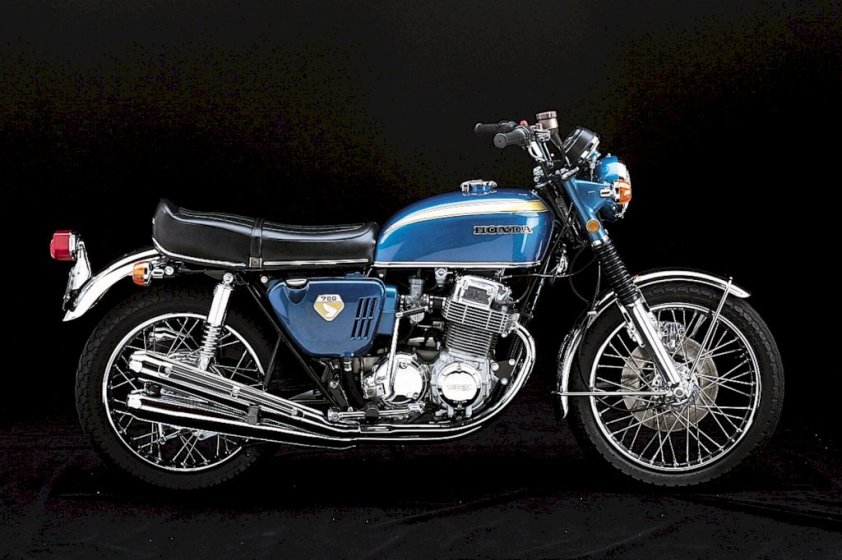
 1969 Honda CB750.Honda Four hundred million! Thats how many motorcycles and scooters the Honda Motor Company has produced since 1948. Founded, of course, by Soichiro Honda, as a purveyor of piston rings he supplied Toyota, which was just starting to produce cars Honda quickly determined that post-war Japan needed cheap transportation and thus was the Dream Model D born, powered by 98-cc two-stoke motor.Since then, there have been many milestones. There was the construction of the original superbike (the CB750) and the original touring motorcycle (Gold Wing), not to mention stalwarts like the Africa Twin 650 and the industrys first dual-clutch transmission motorcycle (VFR1200).But, by far the most important motorcycle in Hondas repertoire accounting for more than a quarter of that 400 million total, making it the most popular vehicle of all time is the venerable Super Cub. Originally conceived as a 50-cc runabout in 1956, it is the Super Cub that spawned a decade of You meet the nicest people on a Honda, the trend that swept the USA during the 60s.Without the Super Cub propelling upstart Honda ahead of traditional giants like Harley-Davidson and Triumph, there would have been no CB750 or Gold Wing 1000. The Super Cub is quite literally the motorcycle that made Honda. That said, while North America remains a prime market for Hondas large touring motorcycles, it merits barely a mention in the companys overall sales. Honda, for instance, celebrated its 300 millionth motorcycle just five years ago, which means its been selling 20 million yes, 20 million units a year every year since. And India and Indonesia account for half 10 million of that number. All of Europe and North America, meanwhile, accounts for just 620,000 bike sales combined.Honda also celebrated 50 years in Canada this year. Vancouvers Trev Deeley (the first Honda motorcycle distributor in the English-speaking world, by the way) and New Brunswicks Northrup family started importing scooters during the 50s before Honda established its official distribution chain in 1969, concentrating on motorcycles until the 1973 arrival of the original
Origin: Honda celebrates building its 400 millionth motorcycle
motorcycle
17th annual Millarville Vintage Motorcycle Swap Meet
 Motorcycles and parts at the Millarville Vintage Motorcycle Swap Meet in the old riding arena. This building collapsed early in 2018, and a new arena has been built in its place. In 2019, the event takes place on Sunday, Sept. 8.Greg Williams Vintage motorcycle enthusiasts enjoy nothing more than rooting around on tabletops and through boxes searching for elusive parts and pieces that will bring an old machine back to life.Since 2003 the Canadian Vintage Motorcycle Groups Rocky Mountain Section (Calgary) has hosted a motorcycle parts swap meet in early September. It started in a small community hall in Inglewood, but in 2006 the event moved to the riding arena at the Millarville Racing and Agricultural Societys pastoral grounds south of the city. Early in 2018, however, a heavy snow load collapsed the riding arenas roof and that left the group without a venue. They scrambled to come up with a plan B and managed to pull off a mostly outdoors swap meet at Millarville.This year, things are different. The Millarville Racing and Agricultural Society has built a new, larger riding arena, and the 2019 version of the Millarville Vintage Motorcycle Swap Meet is ready to take the building for a test ride. A 24,750 square foot steel structure was designed and erected by the Ironwood Building Corp., and the building was up late in 2018. The footprint of the previous arena was 16,000 square feet. Its almost double the size of the old arena, says CVMG-RMS swap meet coordinator Janice Whitby. She adds, Theres new frontage, and the configuration of the building has changed so the table layout will be different this year.I think a lot of people are looking forward to seeing the new venue. Its brighter inside and its a building with unique appeal. The structure is new and fresh it feels modern and its got wood around the interior walls that makes it feel a little warmer, and not sterile.Yes, she says, there is a dirt floor.Its close to dust-free, however, and it helps add to the overall charm of the swap meet, she explains.A diverse range of two-wheeled products, from complete machines to parts, often turn up for sale at the event. For example, the swap meet caters not only to motorcycles, but also to scooters and, occasionally vintage bicycles and everything that goes along with the hobby including riding gear and tools.Personally, I found a really cool Belstaff motorcycle jacket here, and my husband Fred has found parts and pieces for projects that do help move them along, Whitby says.About four years ago Whitby even found a new-to-her vintage motorcycle project.A 1972 Suzuki T350 rolled in, I sat on it and my wallet fell open, she says. I brought it home and now have restored it.Whitby maintains the swap meet often offers something for just about every brand thats out there, from Japanese to European to British to American.And its not just a swap meet for motorcycles and parts, its also a large social event, she adds. I know folks who only see each other annually at this particular meet.Whitby expects about 100 vendor tables will be set up in the Millarville riding arena on Sept. 8, and says the event routinely draws close to 800 visitors. A portion of funds raised is donated annually to the Legion Poppy Trust, and tables are often given to local motorcycle charities to help them promote their own event.Millarville is a destination, its not a swap meet thats just around the corner in the city, Whitby says. That means a number of people choose to ride out and check out the event, but we also see motorcyclists who might be riding by drawn in by our signs on the highway.For many, its a first-time visit, and theyre delighted because they had no idea the racetrack or the swap meet existed.IF YOU GOSeventeenth annual Millarville Vintage Motorcycle Swap Meet, hosted by the CVMG-Rocky Mountain Section on Sunday, Sept. 8 in the new riding arena on the grounds of the Millarville Racing and Agricultural Society approx. 35 minutes south of Calgary just off Hwy 22 and Hwy. 549 (306097 192 Street, Millarville, AB). Doors open at 10 a.m. and close at 3 p.m. For more information, call 430-273-7840, email rms-secretary@cvmg-rms.ca or visit cvmg-rms.ca and click on the Events tab.Greg Williams is a member of the Automobile Journalists Association of Canada (AJAC). Have a column tip? Contact him at 403-287-1067 or gregwilliams@shaw.ca WHAT’S NEXTSept. 15: Sixth annual Magic of Christmas motorcycle toy run. Cost of registration is a new unwrapped toy or minimum $10 cash donation. Registration starts at 9 a.m. at Century Downs Casino in Balzac — breakfast to be served. Ride departs the casino at noon, with a tour to Cremona followed by a turkey dinner at the Grey Eagle Casino. Contact Cheryl at 403-870-3024 or email her at choppergirlcq@shaw.ca for more information.Sept. 28: Annual Call of the West Museum automotive and vintage collectibles swap meet at the High River Rodeo Grounds, $4 admission, free parking,
Origin: 17th annual Millarville Vintage Motorcycle Swap Meet
Aston Martin teams up with an icon to build its first-ever motorcycle
 The Aston Martin and Brough Superior AMB 001Aston Martin When Aston Martin recently announced it was building a motorcycle in conjunction with Brough Superior, most car enthusiasts were probably wondering why the storied automaker was stooping to build a motorcycle.In fact, if anyone is slumming in this new relationship, it is Brough, once the pinnacle of two-wheeled exclusivity and favourite of the most famous motorcyclist of all time.Brough Superior was the brainchild of George Brough, who between 1919 and 1940 crafted some 3,000 some of the most exquisite and exclusive motorcycles the world had ever seen. Most were custom-built, and though the engines were outsourced usually from J.A. Prestwich but later also Matchless almost everything else was hand-hewn in house.Indeed, legend has it that, after H. D. Teague of The Motor Cycle labelled Brough the Rolls-Royce of motorcycles, the famed automaker sent over a representative to tell George to cease and desist advertising as such.Luckily, Brough and his crew were in the process of final assembly for an impending motor show and the Rolls representative was so impressed the techs were supposedly wearing white gloves whilst assembling bikes that he reported back that Broughs motorcycles really did deserve the appellation.What has made the Brough name an enduring legend, however, is the devotion of its most famous client, T.E. Lawrence. You know him better as Lawrence of Arabia, and his love of motorcycles A skittish motor-bike with a touch of blood in it is better than all the riding animals on earth and Broughs in general he owned eight, and gave them all names knew no bounds.He famously died on an SS100 he was trying to avoid two young boys who had wandered into the road and his passing so traumatized his attending physician, Hugh Cairns, that he went on to create the research that paved the way for mandatory helmet use. More recently, Brough was resurrected by long-timer enthusiast Mark Upham in conjunction with Thierry Henriette of Boxer Design, who craft the double-overhead-cam 990-cc 88-degree V-twin on which the AMB 001 is based.In Aston Martin guise, said big-twin is turbocharged for an output of 180 horsepower stock modern Broughs are good for about 120 hp and is mated to a chassis constructed of aluminum, titanium and carbon fibre.According to Aston Martins chief creative officer, Marek Reichman, in addition to applying the skills we have developed for cars such as the groundbreaking Aston Martin Valkyrie, we have also been able to bring our special expertise in the traditional craft techniques to this project.The result is a motorcycle with a double-wishbone front suspension still something of a rarity in the biking world and a completely carbon-fibre body which helps keep the AMB 001s overall weight down to 180 kilograms.Only 100 examples of the 001 will be made available to the public, at a price of 108,000 Euros about $157,200 Canadian and delivery will begin at the end of
Origin: Aston Martin teams up with an icon to build its first-ever motorcycle
Motorcycle Review: 2019 Honda CBR650R
 2019 Honda CBR650RJacob Black There are only 11 letters between F and R in the alphabet. Both are consonants. Both have soft sounds. But the difference between F and R in Hondas lexicon is immense, the former always ladled onto the companys pedestrian models while the latter is reserved for its supersports models.So, the big question for this latest test is whether the rebadging of the CBR650F as an R is just a cynical marketing exercise?The differences between the outgoing 2018 Honda CBR650F and the new 2019 Honda CBR650R are fairly miniscule. The front forks are changed. Inverted, 41-millimetre adjustable forks with compression in the left and rebound damping in the right replace the conventional Showa Dual Bending Valve units. The compression ratio is up slightly to 11.6:1 from 11.4:1, and the 650R is three kilograms lighter. That lightness is less impressive when you realize its all due to the two litre smaller fuel tank, which, at only 15.4L, brings the overall wet weight down to 208 kg. Traction control is new, and so is the slipper clutch. Both seem like performance features but really help make this Honda easier to ride. Hondas pricing is certainly interesting. At $10,199 its decent value, but there are still a few 2018s around that Honda is blowing out at $9,699 and claims $1,500 of savings on their website. Considering the small differences, theres a gap there I dont really understand. Its the same bike, with a slightly more advanced front end and a newer, sexier, but more cynical name.Thats about the end of the bad news, because, F or R, the CBR650R is still a very solid middleweight bike. The truth is, the markets hunger for hyper-aggressive, razor-sharp 600cc sport bikes has waned. Yet middleweight bikes still make sense for a raft of reasons. Insurance, fuel economy, overall cost, comfort, and ease of riding all among them. The shift towards a more accessible sportiness is a sensible one. Hondas not the only one to do it. Kawasaki has a Ninja 650 too. Done right, a 650 is a bike a you can ride around town, while still enjoying a decent level of street cred. You can keep up with larger bikes on most public roads and if you take one to the track, youll have a lot of fun. Road manners on the Honda are good. Its compliant and responsive but never jarring or harsh. Road conditions dont ever upset it. I rode the CBR650F on its press launch back in 2014. During that launch we ended up accidentally on a gravel road, and the sport-focused bike still handled the ruts, grooves and slippery surface with aplomb. The new CBR650R has lost none of that rideability. Typically Honda, typically forgiving, the 650R is far easier to ride than the trailing consonant suggests.The engine is smooth and has good tip-in. The linear, unfussy throttle response is paired with a light clutch and clean-shifting transmission. Given how gently this engine spools up, the traction control is probably overkill. Unlike the ABS, you can turn it off.The CBR650s ergonomics are good and the riding profile is moderately sporty but appropriate for city commuting too. At 810 mm, the seat is fairly high and the pegs are low which helps hide the relatively compact wheelbase of 1,450 mm and improve the amount of room for the rider. It has an upright position, and visibly less ground clearance than a proper sport bike. Again, thats appropriate for this bikes mission, and anyone who does decide to hit a few track days can always buy a set of aftermarket rearset footpegs. 2019 Honda CBR650R Jacob Black I will never stop complaining about Hondas placement of the horn, between the indicator switch and the high-beam switch. How they decided the horn is the most important button on the left-hand grip is beyond me. The screen is hard to read in direct light and the large TFT seems poorly designed. The gear position indicator is welcome, but it dominates the circular digital tach, which is squeezed tightly into one corner of the screen, leaving a very large open space in the middle. The speedo is then comically large. I do like the amount of information shown, which includes average fuel consumption. For those playing at home, my two weeks on the bike ended with an average of 6.6 L/100 km.The CBR650R is a good example of what Honda does well. A pretty bike with a solid base of performance chops in a package that is almost fool- and bullet-proof. Its easy to ride, enjoyable to ride, and just interesting enough to keep you entertained. Its also a good example of what Honda sometimes does poorly even on the four-wheeled front with an awkward instrument cluster that puts emphasis on showing off technical wizardry over and above
Origin: Motorcycle Review: 2019 Honda CBR650R
Vincent: The legend of the fastest motorcycle in the world
 Robert and Kathy Watson with some of their rare Vincent motorcycles.Alyn Edwards In 1948, a British-built HRD Vincent Black Shadow motorcycle taken right out of the shipping crate could do 125 miles per hour. That same year a Black Shadow was clocked at 150 mph on the Bonneville Salt Flats. In 1956 a Vincent in New Zealand held the FIM (International Motorcycling Federation) record at 186 mph.Back in the mid-20th Century this was the worlds fastest motorcycle and it shattered every land speed record in the United States. The Black Shadow is slightly faster than the Vincent Rapide and a fair number of them were sold new in the Forties and early Fifties by Vancouver distributor British Motorcycles.We have the records for every model sold in Vancouver, says Fraser Valley Vincent guru Robert Watson, whose amazing collection includes a 1939 Series A Vincent Rapide plus examples built in 1947 and 1949 along with a single-cylinder 1949 Comet that he affectionately calls Half-a-Vincent.He says the only differences between a Black Shadow and a Rapide are slightly higher compression, carburetors and the letter B added to the number stamped on the Black Shadows engine block. Watsons most collectible Vincent is a 1937 TT-replica one of only 38 pre-war racing TTR bikes built as an homage to the three 1936 TT factory racers that competed in the famed Isle of Man race that year. This was one of two rare Vincent motorcycles that were all apart and for sale in Toronto.I bought a van in Toronto, picked up all the parts and pieces and drove back to Vancouver, Watson says.With five Vincent motorcycles in his stable and a track record of restoring many basket cases, Robert Watson is a world authority on the marque.Why the Vincent?I was about 15 years old when I saw a group of Vincent owners go by in Vancouver. I thought: Is that the mystical black motorcycle that I heard about?Although his first motorcycle was a modest Yamaha 80 purchased when he was in Grade 12, Watson developed a passion for motorcycles and, later, motorcycle racing.He got a degree in industrial design at the British Columbia Institute of Technology and began designing and selling industrial conveyor systems.He bought a new 1979 Kawasaki 550 and went for a ride up Mount Baker with his brother and some of his friends.I had the Kawasaki pinned at one hundred and Dan Smith pulled up beside me on his Vincent and shifts into fourth gear. I had to get one, he says.In 1985, he bought his first Vincent. It was a jigsaw puzzle with all the parts laid out on sheets of plywood. It was the 1949 Vincent Rapide that he has now ridden thousands of kilometres with wife Kathy. They have participated in many rallies in the U.S., Europe and Australia. He has only restored one Vincent that wasnt his.The owners grandfather, Fred R. Hancock, bought the Rapide new in Vancouver on September 23, 1949, he explains. It was crashed in Rossland decades ago and he put it away in his basement in Lillooet where he was the high school vice principal.The restoration took 18 months.The engines are complicated. Just the cams are a horrendous collection of bushings and spacers. You can spend $25,000 in a heartbeat if the motor isnt good, Watson says.The local chapter of the Vincent Owners Club has determined there are at least 70 Vincent motorcycles registered in B.C. The club, with 2,600 members worldwide, operates a parts supply company in England with six employees to keep the supply of spares available to enthusiasts.HRD Vincent made about 1,000 motorcycles before World War two and 11,000 post-war models. The club knows the whereabouts of approximately 7,000 Vincent motorcycles, an indication of how much they are valued. The club has production records with all the correct serial numbers and parts numbers.Its a closely guarded database and you can determine fakes, Watson says.Vincent motorcycles have become highly sought after and very expensive with restored Series A Rapides fetching around US$400,000 and the much coveted and extraordinarily rare Black Lightning models crossing the million-dollar mark at auctions.But to Vincent owners, the real value is riding their motorcycles.I will still run the A Rapide hard up the Duffy Lake Road or thrash the TTR on a track given the opportunity, Watson says. When you get them sorted, they are amazing. Every year when I get on my Rapide and run it out on the freeway, I say, God, I love this motorcycle.Alyn Edwards is a classic car enthusiast and partner in Peak Communicators, a Vancouver-based public relations company.
Origin: Vincent: The legend of the fastest motorcycle in the world
Motorcycle Review: 2019 Kawasaki Versys 1000 LT SE
 2019 Kawasaki Versys 1000 LT SEKawasaki St-Hippolyte, Quebec — For those motorcycle engineers looking to test suspension systems, let me offer you a bit of time- and cost-saving advice. There’s no need to create complicated chassis dynos to replicate all the cracks, crevices and undulations the world’s roads will throw at your new products. Nor do you need to construct, as so many of you have done, multi-faceted test tracks around the world, their roadways emulating the most troubled tarmacs — the most nefarious reputed to be Belgian cobblestone — on the planet. And there’s absolutely no need to trek all the way to the far-flung steppes of Siberia to find pavement perdition. Nope, all you gotta do is plunk your bike in Quebec’s Laurentians and you’re good to go torture testing.Don’t bother asking specifically where because pretty much anywhere will do. St-Jerome is all huge frost heaves and giant craters. Estoril specializes in longitudinal cracks that will swallow a chopper front tire. And Lord, by the time you hit Saint Alphonse Rodriguez — you know the locals take their religion seriously when they name their town after a medieval Spanish Jesuit priest — it feels like Quebec’s highway department is deliberately trying to bend rims. If it’s north of Montreal and west of Trois Rivieres, you’re pretty much guaranteed it’s the worst road in the world. This, of course, makes La Belle Province the perfect place to test a motorcycle whose major year-over-year revision is enhanced suspension, which, if you have not yet guessed what I have been leading up to, perfectly describes Kawasaki’s Versys 1000 LT SE.Now, the Versys 1000 has always had a lot going for it — a smooth, silky 1,043-cc four-cylinder engine, excellent fairing protection and lithe handling. And, truth be told, there is a little more to 2019’s updates than just suspension improvement, an entire raft of new electronic goodies added this year, stretching from cruise control system and automatic cornering lights (that shine brighter the more you lean over) to upgraded traction control, “intelligent” anti-lock brakes and something called Kawasaki Corner Management Function. The big news, however the only thing anyone is talking about is Kawasakis Electronic Controlled Suspension. The same kind of adjustable suspension seen on higher-end BMWs, Kawasakis version is particularly sophisticated, but, after you set those basic settings, the LT continues to monitor the suspensions every movement and makes minute adjustments every millisecond. In other words, even after you set your desired ride quality, KECS continues to alter the suspension parameters according to speed and bump size to optimize ride and/or handling. Too trick!So, how effective is it?Very, in fact, the KECS upgrade completely worthy of the many accolades its garnering. Sport mode, for instance, is perfect for smooth, twisty roads, but thanks to KECSs ability to constantly alter resistance does make it somewhat passable even in La Belle Province. Road proved much more sympathetic, still firm enough that one could play silly buggers but without the forearm jarring compression damping. Rain, meanwhile dialled the suspension all the way back, providing the softest ride, though the lack of rebound damping did have it occasionally flouncing about like an overstuffed 1969 Ford F-150 riding on original shocks.All that said, knowledgeable bikers will probably be ready to put pen to paper or, more accurately, fingertips to keyboard telling me that switching to Road and Rain mode also decreases the engines power output/throttle response; not so much in former, but dramatically so (about 25 per cent) in the latter.So, what do you do if you want the super squishy Rain mode suspension married to Sport modes maximum power? Well, you simply toggle to Kawasakis custom Rider setting that lets you meld superbike throttle response with Gold Wing suppleness. OK, that may be doable, but better perhaps is to, as I did, marry Sports engine and traction control calibrations with softish compression damping, but firmer rebound damping. Then I just left KECS alone.And therein lies the sole caveat about Kawasakis indeed, everyones electronic suspension system. Once youve gotten over the novelty of flipping between modes or constantly customizing your suspension, one tends to find one baseline adjustment and just leave it there. Oh, maybe a few inveterate button pushers continue to juggle their ride quality, but most people just find their favourite compromise and then be done with it.What they will use, however, on a much more frequent basis indeed, what makes all this electronic control truly worthwhile is the electronic spring preload adjustment. Indeed, it is so frequently fiddled with that it has its own button on the left handlebar, the spring preload adjuster allows the rider to compensate for different loads a passenger, luggage, etc. at the flip of a switch. Considering how
Origin: Motorcycle Review: 2019 Kawasaki Versys 1000 LT SE
Motorcycle Review: 2019 Yamaha Niken GT
 I really thought there’d be more gaping, Sideways glances to be sure. Questions even. Some quizzical looks at the very least. Especially from any seasoned motorcyclists that happened by. Maybe even a few curious car guys would manage the casual WTF that is common to every gearhead, even if that particular form of motorization isn’t their gig.But no, the Niken GT, odd double fork arrangement, desultory predatory beak and a front-to-rear weight imbalance that only a mother could love, barely garnered a sideways glance. Oh, there was the occasional gawk and one or two instances of sincere staring, but nobody asked me what it’s like to steer a motorcycle with two front wheels. There were no queries as to its ability to lean into corners, whether it could stand up by itself or even — and this was something I would have asked considering the state of the roads in my home of Toronto — does having two front tires mean you hit twice as many bumps.But there was none of that. Nothing. Nada. Not a single query. I don’t know what it means when a motorcycle company produces something as genuinely outrageous as the Niken and its Leaning Multi-Wheel Technology — for that is Yamaha’s official name for the GT’s novel front suspension — and nobody notices, but that’s exactly what happened. Is the outrageous now so commonplace that it barely garners a second glance? Or am I really the only one interested, the remnants of my now 40-year-old engineering degree the source of an uncommon curiosity. I don’t know. But like I said, I was surprised at the lack of reaction from passersby. Whatever the case, the three-wheeled Niken was the bike I was most eager to test this summer. Oh, I’ve seen — and driven — more than my share of three-wheelers over the years, from Harley’s two-wheel-in-the-back Freewheeler to Can-Am’s only slightly less ungainly Spyder with its twin wheels in the front. But, front or rear oriented, they were basically the same, just a car with one less wheel. No leaning in turns, no scraping of footpeg to be had. In fact, neither alternative offered much in the way of the traditional motorcycling experience other than getting wet in the rain.Not the Niken. Two wheels it might have in front, but the way that Yamaha has arranged those twin forks and other joints and linkages, the GT feels very familiar. Oh, the width of the front end — both mechanical bits and the bodywork — surprises and one does have to get used to the weight at walking speeds. But it steers like a motorcycle, stops like a motorcycle and will topple over like a motorcycle if you don’t put your feet down at stoplights.Indeed, other than being a little ponderous at the slowest of crawling speeds (caused by the friction of two tire contact patches) and then a smidge reluctant to turn at very high speeds (this time the result of the extra gyroscopic forces of two wheels), the Niken felt every bit the common motorcycle on most roads. Countersteer into corners and the GT leaned over with a neutrality of steering belying its odd front end. Grab the front brake and you have twin contact patches to scrub off speed.All normal. Why the twinned front end then, you ask? Well, firstly, Yamaha has a history of this funny front end stuff. Back in the ‘90s it produced the equally novel GTS1000 with a James Parker-designed front wishbone suspension. Technologically speaking, however, the Niken’s twin front tires are of particular benefit when the road turns nasty, especially wet and nasty. With two front tires, grip at the front is heightened when a single tire might hunt for grip. Likewise with two wheels, if a bump sends one wheel careening while you’re leaned over, there’s still one more to hold down the fort. On a dry, well-paved road, the Niken is no quicker than the Tracer GT from which it liberates its 847-cc three-cylinder engine. On a wet, frost-heaved road, you’d likely feel much more confident aboard the three-wheeler than anything with just two.If the novel suspension layout has any weakness, it is that it highlights the limits of the rear shock Yamaha chose. Where the front end is particularly well damped and compliant, the rear shock is more than a little stiff. Bumps that the front end barely skips over send a shock through the rear end. With all the effort it put into the front suspension, I don’t understand why Yamaha didn’t install a superior rear shock.As, for the rest of the Niken, it is very much a comfortable “GT” bike, the seating position — wide adventure-style handlebar, wide, flat seat and low footpegs — calibrated to eat up miles. Despite the growl from the engine, there’s precious little vibration in the handlebar and the seat is amongst the most comfortable available on stock motorcycles. As to the heart of the Niken, the aforementioned 847-cc triple, it’s one of the sweethearts in Yamaha’s lineup. Torquier than a four, more growly than a twin, three cylinders strike a nice balance between two and four. Its 115 or so
Origin: Motorcycle Review: 2019 Yamaha Niken GT
Lorraine Explains: Deadly motorcycle crashes, and the drivers who cause them
 A motorcycle driving by cars on a city street.Getty Two weeks ago, at 7:30 am, a motorcyclist in Burlington, Ontario suffered life-threatening injuries when a car turned left in front of him. Later that night in the same city, a motorcyclist was killed when an SUV turned left in front of him. The next day, an Oakville driver was charged with making an unsafe left turn, causing a motorcyclist to be violently thrown and severely injured; the rider and bike ended up 40 metres from the point of impact.The same weekend in New Hampshire, seven members of a motorcycle club – the Marine Jarheads, made up of Marines and their spouses – were killed when a pickup towing a flatbed crashed into them on the highway. The 23-year-old driver has been charged with seven counts of negligent homicide, though his driving record was already a disaster. He’d been charged with operating a vehicle under drugs/alcohol in May (cops found a crack pipe on him) and he had a rollover in Texas earlier in June. His licence should have been revoked, and the Registrar of Massachusetts’ motor vehicle division (where the trucking company he drove for operates from) has resigned.Ive taken so many advanced driver training courses over the years, Ive lost count. But the motorcycle training I took remains the most memorable, the most sobering, and the most valuable. You truly understand just how vulnerable you are, no matter how much bike you buy, no matter how much you invest in leathers and safety gear, no matter how much you spend on a helmet. You learn to drive as if everyone around you is going to kill you, because some of them are.As for the idiots who insist on weaving in and out of traffic on their crotch rockets, theres a famed biker adage seemingly lost on the young: There are old motorcyclists. There are bold motorcyclists. But there are no old, bold motorcyclists.Motorcycles have been on our roads about as long as cars have. This is not new. Motorcycles change, vehicles evolve, safety improves everything gets better, it seems, except how we interact with each other.Eight years ago I cut a motorcycle off, and I wrote about it. I didn’t mean to, he was speeding, but it didn’t matter. A life was at stake. I was shaking as I wrote it, and reading it again is still just as visceral as when it happened. I heard from riders around the country, and braced myself for the fallout. Instead, I got thank-yous. Not for nearly hitting one of their own, but for admitting I’d made a mistake and put him in danger. Apparently, riders are not used to drivers owning up to their own mistakes.The first three crashes at the top of this article shook me, too. Any motorcyclist will tell you that someone in the opposite direction making a left turn puts them on even higher alert. Left turns, in general, are one of the most deadly moves we make every day, but they make anything smaller – a pedestrian, a cyclist, a motorcyclist – nearly invisible. A New York City Department of Transportation study sums it up thus: “Left turns are more dangerous than right turns for three main reasons: left turns can be taken at a wider radius, which leads to higher speeds and greater pedestrian exposure; the driver’s visibility is partially obscured by parked cars and the vehicle’s A-pillar; and left turns are more complicated than rights, and require more mental and physical effort (‘driver workload’) than right turns.”Drivers can be so focused on finding their break in a flow of traffic that they fail to see pedestrians in a crosswalk, or other smaller oncoming traffic. I don’t know precisely what happened in those Burlington instances, and the police are asking for witnesses, but the onus to prevent a crash is on the person making the left-hand turn. Unless those bikes were going an excessive speed, one life was needlessly ended and one forever changed. Safe riders will try to maximize their visibility to you. They will ride behind you to the left, so you can see them in your rearview mirror. Multiple riders will ride two abreast.The MTO states, “(a)ll motorcycles must have a white light at the front (headlight) and a red light at the back (rear or tail light) and these must be used at all times of day and night.” You’ll even see some motorcycles with a modulating headlamp – it’s pulsing – in the daytime. It helps makes drivers more aware. Sensors kick in to keep the beam steady at dusk. The slaughter on the New Hampshire highway was just flat-out murder. New Hampshire doesn’t have a helmet law, and their slogan is “Live free or die.” I was there the weekend so many members of that club were wiped out, and it is prime season for motorcycles and RVs. The winding two-lane blacktops throughout that part of the country are spectacular for driving, and we saw countless bikes. The only time I noted a helmet-less head was in town, which was stupid. Those members of that club came from several states, and in every picture posted on the internet of the club (and there
Origin: Lorraine Explains: Deadly motorcycle crashes, and the drivers who cause them
Motorcycle Review: 2019 Honda Rebel 500
 2019 Honda Rebel 500Jacob Black / Driving Its the rear brake reservoir that sealed it for me. The detail on this one feature is how you know Honda cared for how this bike is styled; the fit and finish is better than an entry-level bike has any right to be. Im impressed by how much licence Honda gave its designers and how much they let them execute their vision.Is Hondas entry-level cruiser aggressive and polarizing? Absolutely. On an aesthetic scale of V-Rod to CTX, the 2019 Honda Rebel 500 swings toward the V-Rod. It looks tough, and more than one Harley-Davidson owner has given the Rebel an appreciative glance. The high-tilted, 11.4-litre fuel tank is retro cool in spirit, but angled and chiseled in a very modern way. Honda designed this bike from the ground up to make it easy to customize, with a completely removable rear fender and subframe making it even easier to accommodate the plethora of aftermarket options. Im surprised I dont see more variations of this bike on the road, but customers seem to enjoy the stock look. I agree with them.The Rebel 500 shares everything but the engine with the Rebel 300. The 500 is $7,199; the 300, $5,299. If youre lucky, there are still a handful of 2018s on showroom floors, and you might save some money going for one of those. But the fundamental question is, is the 500 worth $1,900 more than the 300? The simple answer is Yes. It doesnt matter that at 188 kilograms, its 20 kilos heavier than the 300, because the 471-cc liquid-cooled twin is one of the smoothest powerplants in the entry-level market. The throttle is well-weighted and the transition from closed throttle to open is wonderfully smooth not always the case with motorcycle fuel injection systems which means newer riders dont have to manage that untidy, herky-jerky feeling you can get with many small and medium engines. Honda has a knack for making bikes idiot proof, and this is a good example of that ethos.In that same spirit, the clutch pull is light and its friction point is quite distinct, making it easy to navigate in town. Theres enough grunt to cut through city traffic and enough top end to keep up on the highway. Though there isnt a tachometer, the 45-horsepower parallel-twin tops out at around 8,500 rpm, giving it plenty of room in the rev range for passing on the highway.ABS is standard, which is appropriate for this class and Id argue any class of street bike. The single, 296-millimetre rotor up front is paired with a two-piston caliper I still think a 188 kg bike should have bigger brakes. The back brake is a 240-millimetre single-piston disc, and feels a lot less wooden than other back brakes. More than on most beginner bikes, I found myself using the back brake as well as the front.The heft of the 500 is well hidden by its low 691 millimetre seat height. Its comparatively long 1,491-mm wheelbase, meanwhile, gives the Rebel more stability and road presence than a 500 ought. Does it handle as well as a sport bike? If you care, you havent read this far. The-41 mm conventional forks and twin rear shocks are adequate and provide good levels of compliance. The wide bars help get the bike tipped in, and ground clearance is more than enough for riders of this class. Road manners are relaxed, and theres plenty of travel to manage the potholes without harshness.There are a few quibbles however. The clutch cover, for instance, intrudes into the right leg area. This is a major flaw in the ergonomics of this otherwise laid-out motorcycle. The other is Hondas habit of putting the horn above the indicator switch on the handlebar. The result is I kept getting flipped off when all I was trying to do was activate the turn signal.The gauge cluster is also a little tricky to read when the sun is shining directly on it. The fuel gauge is a welcome addition but a lot of entry-level bikes now have tachometres and gear-position indicators. This cluster is simple and uncluttered, but decidedly plain compared to some of its competition .Ultimately, the Rebel 500 is exactly the right bike for you if you value aesthetics, even more so if youre looking for something easy to ride comfortable and confidence inspiring that also packs a surprising road presence. There are other entry level bikes for less money but none that are cruisers this well
Origin: Motorcycle Review: 2019 Honda Rebel 500
Motorcycle Review: 2019 Kawasaki W800 Street
 2019 Kawasaki W800 StreetJacob Black / Driving Kawasaki has jumped on the retro-bike bandwagon with a fervour. Its almost like they spent actual time and energy analyzing emerging trends and used the results to make actual money. Well, motorcycles that make money, at least.Hipster chic? Check. New-rider friendly? Check. The 2019 Kawasaki W800 Street looks every bit the bike that Rosie the Riveter would have ridden to work, and that, in this particular era of our sport, is a very positive thing.At $9,999 before tax, the 2019 Kawasaki W800 Street is accessible and I dont mean only in price point. The banana handlebars and mid-mount pegs, coupled with the low(ish) 770-millimetre seat make for authentic vintage styling but more importantly, excellent ergonomics. The comfortable riding position and wide bars help make the 220-kilogram chassis shrink in heft and presence. The assist and slipper clutch tames the five-speed gearbox, and the 773-cc parallel twin is civll no matter where you are in the wide powerband.Thats not to say its equally smooth all the way through. Its not. Above 6,500 rpm, the W800s big twin is buzzy, and it lugs below 4,000. Some folk seem to enjoy this chug-a-lug at low revs personality; I suppose, for them, its a reminder of a simpler time. Between 4,000 and 6,500 rpm though, the W800 powerplant is positively silken. Theres a pleasing sense of presence and adequate speed, all coupled with the whistle of its fairly unique bevel gear cam drive (think early Ducati supersports here). Throttle off quickly and you get a dull burble in the traditional pea-shooter tail pipes. Not the raucous, sporty crackle of new bikes, its more the Hey, is this thing fueled? right of an old carbureted British twin. Kawasaki has hidden its EFI system not just aesthetically, but in spirit as well.Theres a caf racer version of the W800, but the higher-handlebarred Street is the better aesthetic fit. And if style and fashion matters to you, exclusivity probably does as well, so itll probably be appreciated that you cant get the Street version in the U.S. Plus one for us, eh?The bird-cage heel protector ties well visually into the side stand, which frustrated me as I consistently used the wrong piece of metal to try and lower the stand. Owners will get past this issue quickly, but as a temporary rider, I found it annoying. The twin analogue gauges are easy to read and operate, but even the Z125 has a fuel gauge and the W800 deserves/needs one too.The bevel-gear cam drive is set off in chrome on the side of the engine, and its this detail, more than any other, that really drags the W800 firmly into nostalgia land. The rubber fork gaters contribute, and help disguise the 41-millimetre conventional forks, their beefy size which helps handling a bit much for a supposed retro. The twin rear shocks are also an appropriate aesthetic choice and come with adjustable preload I wish Id adjusted a click or two. On bad roads, the rear suspension of the new, firmer, and stiffer cradle chassis was a little too hard. The 18-inch bias-ply tires left little to the imagination, and on uneven roads took a little getting use to. They conduct every imperfection to the handlebars with high fidelity.That firmness betrays the modernity of this bike, but so do the mirrors, albeit in a more positive way. The mirrors remain crystal clear and effective at all speeds, never vibrating or blurry. Whoever damped these mirror stems needs a raise.A single front disc is period appropriate, though at 320 millimetres, its happily larger than the original W bikes would have carried. The 270-millimetre disc at the back would have been a pretty soggy drum back in the day; sometimes, authenticity is best left in the parts bin. These brakes are worthy of the street, with decent feel and acceptable power. ABS is standard too. Will you outbrake anyone? No. Thats not what the bike is for. Indeed, thats another attribute in the pro column for the unassuming Street especially compared with the caf racer version. It has no pretentions to modern sportiness. Its just good at what its supposed to do.Which is be a retro bike that feels like a retro bike while remaining enjoyable and more importantly easy to ride. You can get retro in a lot of places Triumph, in particular, specializes in the breed but I think Kawasaki has done a better job of matching aesthetics to spirit and authenticity. The W800 adopts modern touches where they make a difference and keeps true to the old school where it
Origin: Motorcycle Review: 2019 Kawasaki W800 Street
 All about car