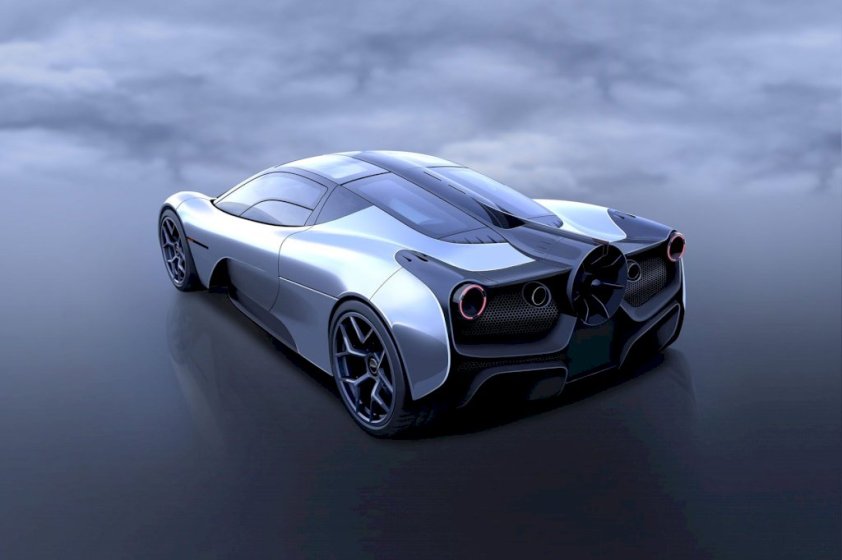
 Gordon Murray has released the first renderings of his sequel-to-his-world-changing-McLaren-F1, and while it does indeed look like it has the potential to be the last great sports car, it still has a lot to live up to.Powering the new car, the T.50, will be the best engine in the world, a V12, displacing 3.9 litres and producing 650 horsepower. It will be built by famed engine builder Cosworth, and rev to 12,100 rpm.The styling is distinctly reminiscent of the 1990s McLaren F1, albeit slightly tweaked. Oh, and theres obviously now a huge fan protruding from its rear.Thats because the T.50 will also use aerodynamic technology based on fan car concepts from the past. The first car to use this tech was the Chaparral 2J, which had two snowmobile motors in the rear that would suck air out from under the car, sticking it to the pavement. The car was quickly banned from racing. The tech found itself in racing once more, however, in the Brabham BT46B Formula 1 car, which was also designed by Gordon Murray. Unfortunately, that car only raced once before team boss and future F1 chief executive Bernie Ecclestone shut down the project over concerns the upset from other teams could collapse the Formula One Constructors Association.The McLaren F1 was also supposed to have this fan tech, but Murray ran out of time to implement it. The T.50 will weigh just 2,160 pounds, much lighter than the 2,500-pound F1, so it will need all the help it can get from gravity and
Origin: Gordon Murray’s T.50 will use fans to vacuum the supercar to the road
supercar
Is a supercar still fun to drive in traffic?
 If you had asked 13-year-old me if I wanted to drive a supercar everywhere, I would have said absolutely. My younger self would say I would drive it to the grocery store; I would drive it to the movie theatre; and that of course I would drive it to work every day, likely at 200 mph the entire way there. Well, 13-year-old me didnt think about speed limits, speed bumps and speed cameras, all of which are facets of the real world in which even the most dreamy of supercars must exist. And its hard to think of one dreamier than this.The 2020 McLaren 720S Spider is the latest carbon-fibre missile from McLarens Super series of cars. The numbers surrounding this car are easy to find and staggering. You can Google up the Wikipedia list of fastest-accelerating production cars and find it there just behind the LaFerrari and ahead of a slower car called the Bugatti Veyron.It has doors that go up, electric tangerine paint (McLaren calls it Papaya); carbon-fibre aero bits everywhere you look; and, of course, a 710-hp V8 flanked by a pair of gnarly turbochargers. Given a long enough stretch of open pavement, it will do 217 mph (349 km/h) flat out. But were not going to find a stretch of road like that. No, were going to find out what its like to commute to work, in the real world, in a supercar. Now you can call this a waste of such high-calibre machinery and youd be right we are using a thoroughbred to pull a plow, as it were. If you want to know what the 720S is like on a racetrack, you can read our track test here; and if youd like to know what its like on winding backroads, check our first drive of the 720S Spider here. No, for our third drive of the spectacular 720S, we decided to use it like regular car. Which it absolutely isnt.Usually I try to avoid traffic, but for this test I threw myself straight into the wood chipper to slog it out with all the other 9 AM commuters. Immediately after setting off, the first thing you realize is how stiff the McLaren is over crumbling pavement. Of course it is. Its meant to feel grounded and stable at 200 mph. You feel every single imperfection in the road, and in Toronto, there are many to be felt. The seats are supportive, though not incredibly so, and the seating position, while natural, is almost normal. Whats not normal is the feeling of your butt skimming over the pavement with maybe three to four inches of carbon-fibre tub separating you from the ground.Even at low speeds, its obvious that this is no regular car. There is zero latency in the steering and directional changes happen right now. Mid-throttle driving will make the turbo blow-off valve whistle amusingly. You also just feel special sitting around in an alcantara-lined super-space pod like the McLaren. But in the same way that a Corolla isnt built for the race track, the McLaren wasnt designed for street driving. I can only imagine what it would be like if snow or ice was added to the mix. Dont get me wrong, its not that its too fragile for street work. Even on the hottest of days, the 4.0-litre V8 stayed cool, and thanks to superb air-conditioning, I stayed cool as well! But the McLaren is very low. Youll fret every raised manhole cover and every pothole in this car. I found myself on a one-lane construction zone where they were grading the road. I was confronted with a raised manhole cover and had to move construction cones while blocking traffic in my orange supercar to go around it. Not subtle.The McLaren simply isnt built for commuting. Its built for something more. You can commute in a McLaren in the same way you can track a Corolla: Itll do it but it wont be happy about it. Will you be happy commuting in a supercar? Fleeting moments of joy are possible when supercar commuting, but the opportunities you have to actually use the power are few and far between. Sorry, 13-year-old me, the future just isnt the way you imagined
Origin: Is a supercar still fun to drive in traffic?
How Croatian supercar firm Rimac is shaping the future of fast cars
 Thank BMW. Or Tesla (the man, not the car company). Or even YouTube. Between them, they helped to kick-start a car maker like no other: Rimac. For one thing, it’s based in Croatia, a country better known for spotty dogs, medieval HBO blockbusters and some of the world’s best beaches. For another, it doesn’t produce many cars and its CEO was born after the launch of the Ferrari F40 and was once best known for flogging a green E30-generation BMW 3 Series around race tracks. But Rimac is helping to shape the future of fast cars, specifically those powered by electricity. That was a point rammed home during a recent visit to the unassuming factory on the outskirts of Croatia’s capital, Zagreb. By the time Ms Google had directed me to the alleged location, I was convinced I was in the wrong spot. Nondescript warehouses are surrounded by the occasional plot of unkempt grass and weeds. It’s far from the no-rock-out-of-place precision of Woking or the grandeur of Goodwood. But follow the signs around the back of an industrial estate and things turn more professional, with R-badged flags waving in the breeze. A deep blue hue surrounding the top of the blocky building contrasts with the overcast sky and glass panels are peppered with pictures of cars, a Lotus-like stature the only clue to something special within. The car park is strangely devoid grey sea of Opels, Volkswagens and the occasional Mercedes-Benz, some with a snazzy set of alloy wheels and the occasional splash of yellow or green. A couple of Teslas, with charging cables snaking from them, are the only clues of automotive appreciation. There’s not a single Rimac, which must make it the only car factory in the world where at least some of the machines produced there aren’t dotted around the car park. Blame it on volumes. Since producing its first vehicle in 2016, Rimac has completed only five full cars. Not five thousand. Not five hundred. Five. It works out to about one car every seven or eight months. A wave of productivity means another three are in various stages of construction while I’m there, body panels stacked and awaiting fitment to complete the planned run of eight Concept_Ones. The car is a two-seater with batteries lining its floor and an electric motor on each wheel. Although tyres and generic components are sourced from suppliers, most components – including air-con units, lights and bumpers – are produced in-house. The result is a sleek sports car that’s good for something north of 1200bhp. Company founder Mate (pronounced ‘mah-tey’) Rimac describes it as “an electric car built by petrolheads”, which gives an idea of his headspace. For the trainspotters, there’s even a hint of Croatian design – Mate is intensely patriotic – with the air intakes that hug the doors being tapered like a necktie, a fashion item invented by the Croatian army. It’s the upcoming C_Two that is planned to send more of a jolt through the hypercar world. The philosophy doesn’t change – big electric power in a two-seat sports car – but the execution does. “The Concept_One was more of a learning project for us… The C_Two is light years away,” says Rimac marketing chief Marta Longin as we wander the clinically clean facilities that are eerily devoid of cars. Claimed to make 1888bhp, it promises new levels of electric performance, blitzing the 0-62mph sprint in 1.97sec and hitting a claimed 258mph top speed. That it boasts a WLTP-certified range of 342 miles reinforces the breadth of engineering beneath an active-aero body constructed of what’s claimed to be the single largest piece of carbonfibre on any production car. The planned production run is 150 units at a rate of three a month – still tiny numbers, even in the world of hypercars. It will take more than four years to build the lot. But it’s not complete cars that are the financial heartbeat at Rimac, as Mate learnt not long after registering it in 2009. He describes the brand as “helping other companies to build interesting products and electrified, connected, smart vehicles”. As Longin describes it, the vehicles are “a perfect showcase of what we can do”. Tracing Rimac’s history shows it to be radically different from other brands. There was no bolshie concept car sprouting plans to knock Ferrari off its pedestal. No gazillionaire investor promising to shovel copious funds through the back door until success was guaranteed. And no mysterious alliance with a tech giant intent on showing car makers how to build cars. The one area where Rimac did follow a more traditional path was in almost going broke. A Middle Eastern sheikh initially promised investment money but the deal went sour. Mate was more visionary than finance guru. “We had no money, absolutely no money,” says Longin of those early years, recounting the time the electricity was cut off (somewhat of an issue for a manufacturer of electric vehicles). She blames it on various factors, including no
Origin: How Croatian supercar firm Rimac is shaping the future of fast cars
2019 Luxury & Supercar Weekend takes flight
 Beautiful cars and well-dress admirers are the order of the day at the 10th annual Luxury Supercar Weekend at VanDusen Botanical Garden in Vancouver.Postmedia VANCOUVER The kids are back to school, the white shoes are put away for another season and Canucks training camp is just around the corner.All of which means its time once again for VanDusen Botanical Gardens to be transformed into the greatest outdoor car lot imaginable.The 10th annual Luxury Supercar Weekend takes place tomorrow and Sunday and as usual is offering up a mouth-watering display of supercars, luxury cars and even a few classics for the discerningand typically well-dressedshowgoers. Theres also a live supercar auction operated by Adesa and great food and beverages available throughout the garden grounds.As has been the case since show founder/organizer Craig Stowe brought his dream of a highend car show to Vancouver a decade ago, this years event offers a new twist: an airplane.Here are four reasons to visit this years show (but trust me there are many more): The ICON 5 recreational airplane will share lawn space with the usual array of mouth-watering supercars and luxury cars. ICON ICON A5Recreational aviation has taken a great leap forward with this U.S.-built amphibious light-sport aircraft. A concept aircraft was first flown in 2008, and creation of the production tooling began in December 2012. Its designengine in back, low instrument panel and panoramic canopyprovides unique views for the pilot and passenger. It has folding wings, a spin-resistant airframe, an onboard parachute system, a range of 427 nautical miles and a maximum speed of 176 km/h. Price: US$389,000. Pininfarina Battista File photo PININFARINA BATTISTAThe Pininfarina Battista is an electric sports car manufactured by Munich-based Automobili Pininfarina with roots in the Italian car design firm and coachbuilder Pininfarina SpA. The name Battista is a tribute to Pininfarinas founder Battista Farina. Unveiled earlier this year at the Geneva Motor Show, the two-door coupe is powered by a 120 kWh battery pack that sends power to four motors at each wheel to produce a monstrous 1,877 horsepower and 1,696 lbs.-ft of torque. It has a carbon fibre monocoque chassis, boasts 21-inch wheels, and a reported full-charge range of 451 kilometres. Pagani Huayra BC Pagani 2020 PAGANI HUAYRA BC ROADSTERWith a sticker price of US$3.4 million, this street-legal hypercar isnt for the light of wallet or shy of attention. Its twin-turbo 6.0-litre V12 engine produces 745 horsepower and ultralight bodymade of a new material called carbon triax that Pagani claims is 50 per cent lighter and 20 per cent stronger than your garden-variety carbon fibreunderscore its track focused design. Theres even a bit of sentimentality in this wicked whip, as the BC refers to Benny Caiola, the first-ever Pagani customer. 2019 BMW M5 Competition Derek McNaughton BMWThe German automaker has brought special vehicles to the show in the past and for this years event hosts the national premiere of a unique-to-Canada BMW M vehicle (so secret that we wont know what it is until the eve of the show itself). What we do know is the exclusive, limited-edition model pays homage to a rarely shown concept car from the 1990s. Other vehicles in the BMW paddock will include the first-ever BMW X7, the BMW M850 Gran Coupe and the BMW M5 Competition.IF YOU GOWhat: 2019 Luxury Supercar WeekendWhere: VanDusen Botanical Garden, 5251 Oak St., VancouverWhen: Saturday, Sept. 7 11 a.m. to 5 p.m.; Saturday Supercar Auction at 1:30 p.m.; Sunday, Sept. 8 11 a.m. to 5 p.m.Tickets: Online at luxurysupercar.com and on site on days of show.Website:
Origin: 2019 Luxury & Supercar Weekend takes flight
The Drako GTE electric supercar allegedly boasts 6,491 lb.-ft. of torque
 The electric car market is far from crowded, but the frequency of new arrivals is definitely increasing.Drako Motors is the most recent EV-maker to enter the scene, and while the Silicon Valley-based brand hasn’t put out a production car yet, it has plans to hit the ground running with this four-passenger luxury car. Luckily, that car will allegedly have a helluva stride. Drako says its GTE will use four electric motors to make a combined 1,200 horsepower and 6,491 lb.-ft. of torque, and employ that twist to get it up to a top speed of 216 mph (332 km/h).The EV newcomers teased the car with a photo and a 10-second clip showing the same image and a date: 08.16.19.There isn’t much more known about the Drako GTE yet, other than the very-hard-to-believe ludicrous numbers and the fact that it set a lap record for electric vehicles at the Nürburgring in 2015 with a time of 7 minutes 49.04 seconds. As for its styling, Drako promises the car will offer luxurious “iconic Italian design” and enough room for four passengers and their luggage. The Drako GTE will make its public debut at the eclectic automotive gathering known as The Quail, in Monterey, this
Origin: The Drako GTE electric supercar allegedly boasts 6,491 lb.-ft. of torque
Watch: Toyota’s new GR Super Sport supercar spotted at Fuji
 Toyotas GR Super Sport Concept, built with Gazoo Racing, on display at the 2018 24 Hours of Le Mans.Handout This past weekend, Toyota Gazoo Racing won the Le Mans 24 Hours in France with a one-two finish following an intense final hour of the FIA World Endurance Championship season. One day later, Toyota’s new GR Super Sport road car showed up for track testing at Fuji Speedway. And guess who was at the wheel? None other than Mr. Akio Toyoda himself. To recap, the GR Super Sport first showed up last January at the Tokyo Auto Salon. Looking for all the world like a Le Mans racer for the street, the machine was said to be powered by a twin-turbo 2.4-litre V6 lashed to a hybrid system. The works of it should make somewhere in the neighbourhood of 1,000 horsepower. You know we live in a gearhead’s paradise when four-figure power outputs are mentioned almost in passing. This road car will form the basis of Toyota’s entrant into the new Hypercar class of racers. They will form a new top category of cars, replacing the current LMP1 prototypes, and be introduced from September 2020. Unlike the current spaceships, the general thought behind the creation of this class is to host cars that are instantly recognizable by their marque. They are charged with a performance goal of 03:22.00 during qualifying at Le Mans. For comparison, this year’s LMP1 pole-sitter ran a 03:15.497. If you’re interested in all the details of this new class, check them out here. As for the machine seen tackling Fuji, its camouflaged bodywork doesn’t give much away in terms of styling choices. We do get a shot of the interior around the thirty-second mark, showing a focused cockpit with a steering wheel surprisingly devoid of the typical myriad of race car controls. A centrally-mounted screen appears to show the GR Super Sport rocketing down Fuji’s main straight at 252 km/h. Cars generally get up to 275 km/h at the end of that stretch, so the GR SS certainly has the goods. No timeframe has yet been announced for
Origin: Watch: Toyota’s new GR Super Sport supercar spotted at Fuji
BMW’s M might build a standalone supercar
 BMW M1 BMW’s M performance division is changing its mind about not building a standalone model, and is now instead studying how to build one. “We are investigating M variants that may also be standalone; that don’t have a predecessor,” BMW M chief Markus Flasch recently said in an interview with Australia’s Car Sales. The exec also noted the cars may not be range-toppers—the company’s already chosen specific categories in which the vehicles could reside. Flasch has previously said the new BMW M8 offers supercar-like performance, so the standalone model won’t be faster than the flagship GT. If the standalone model isn’t range-topping, then it isn’t likely we’ll see a competitor to Audi’s R8, or the Mercedes-AMG GT. A concept car is planned to be revealed at the end of June that should give us a better idea of things to come. Electrification and self-driving are expected to be present on the concept. If you’re old enough to remember it, BMW M did have a standalone supercar in the late ’70s; it was called the M1. Although the car was built for racing, the rules were changed before it was able to actually compete. It remains the only true supercar BMW ever built. The new M car is still very much in the early stages of study, but the company could have the vehicle approved before M’s 50th anniversary in
Origin: BMW’s M might build a standalone supercar
Ultima unveils road-legal 1200bhp V8-powered RS supercar
 Leicester-based sports car manufacturer Ultima has revealed the new RS supercar, its fastest road-legal model yet and featuring up to 1200bhp. Based on the firm’s limited-run Evolution, the RS gains a number of modifications and enhancements to the powertrain, bodywork and chassis to maximise performance. The gel-coated bodywork of the RS has been designed with a strong emphasis on functionality. A 1780mm rear wing works alongside carbonfibre front and rear splitters and wheel-arch vents to enhance downforce, aerodynamic performance and engine cooling, while the new model’s cabin has been subtly reshaped to reduce frontal area. There are three powertrain options, each taken from Chevrolet’s range of Euro 6-compliant V8 engines. Entry-level models are powered by the 480bhp LT1, capable of 0-60mph in 3.3sec and more than 180mph. The more powerful LT4 unit packs 650bhp and will take the RS to around 210mph. The flagship 800bhp supercharged LT5 unit produces 800bhp in standard form, but can be tuned to offer up to 1200bhp, which the company says gives the RS “the potential to outrun every other road-going hypercar on the planet”. In this form, Ultima says the RS will sprint from 0-60mph in 2.3sec and can exceed 250mph. Power is fed through a six-speed manual Porsche gearbox, with the company stating that a PDK unit would not be “in keeping with the ethos of an Ultima”. The RS sits atop Ultima’s own 19in lightweight wheels, which are wrapped in high-performance Michelin tyres. Stopping power comes from a set of 322mm AP vented discs as standard, but optional 362mm AP grooved units and upgraded six-piston calipers can take the RS from 100mph-0 in 3.3sec, 0.47sec quicker than the McLaren Senna performed in our tests last year. The model’s fully adjustable suspension system provides nine different angles of attack, with an optional front-end hydraulic lift mechanism enhancing on-road usability. Inside, Ultima has installed a fully welded and powder-coated roll-cage, half-leather sports seats with lumbar support, an Alpine infotainment system with sat-nav and Bluetooth options, and a bespoke luggage set with RS branding. Pricing has not yet been confirmed, but the company’s website says the model can be bought for the same price as a “mundane new BMW M3”, suggesting it will start from around £60,000. Customers can contact the company for a quotation, but Ultima is warning that lead time for a fully built ‘turnkey’ model is currently more than two years. The parts for a self-assembly model can be delivered in 22 weeks. The RS will make its public debut at the Goodwood Festival of Speed from 4-7
Origin: Ultima unveils road-legal 1200bhp V8-powered RS supercar
Lamborghini heads off-road with new Huracán Sterrato supercar
 Betcha didn’t know you needed an off-road Lamborghini Huracán, right? Well, neither did we. Until now. Apparently, Lambo knows what gearheads want before we do. Called the Huracán Sterrato – a word which, loosely translated, refers to a type of pavement made of rough crushed granite – this concept is based on the V-10 Huracán, and draws on Lamborghini’s off-road expertise exemplified in the Itchy Urus super-SUV. It uses the same 5.2-litre naturally aspirated engine, belting out 640 horsepower and a good bit of Italian swagger. Here’s where things get interesting. The company says its all-wheel-drive system is calibrated for off-road driving, including “low-adherence surfaces.” Your author had plenty of experience with those in college, but none of them involved Lamborghinis. The system is also said to provoke oversteer in certain situations, placing this bad boy squarely at the corner of yee and haw. In addition to fiddling with the traction systems, Lambo went ahead and gave the thing a lift kit. Well, a lift kit of sorts, anyway. Ground clearance is heightened by 47 mm, with the car’s front approach sharpened by 1 per cent and the departure angle enhanced by 6.5 per cent. Your author never thought he’d use the words “departure angle” and “Huracán” in the same post but here we are. The wheel track is enhanced front and rear by 30 mm, with 20-inch wheels on tires set into new wide-body wheel arches featuring integrated air intakes. The Sterrato is fitted with underbody reinforcements and body protection, including a rear skid plate that acts as a diffuser. A specially-designed interior trim reflects the sporty off-road character of the Sterrato, featuring a new lightweight titanium roll cage, four-point seatbelts to the new carbon bi-shell sports seats and aluminum floor panels. Keep in mind that Lambo campaigned modified Jarama and Urraco models back in the ‘70s that were pressed into desert-going high-speed duty, so this isn’t the company’s first kick at this particularly outrageous can. In fact, we think it makes us love the absurdity of this Sterrato even
Origin: Lamborghini heads off-road with new Huracán Sterrato supercar
Koenigsegg supercar due in 2020 with electrified 5.0-litre V8
 Koenigsegg is planning to attract new customers with a much cheaper and higher-volume new model, according to boss Christian von Koenigsegg. It’s set to be revealed next year, with production beginning soon after. The Swedish hypercar maker is now able to make use of far greater economies of scale thanks to a £130 million investment earlier this year by Chinese-owned firm New Electric Vehicle Sweden (NEVS, producers of a Saab-based EV). The partnership has given the firm a 20% stake in Koenigsegg’s parent company, with further money to be invested in a joint venture to develop a project for “new and untapped segments”. Von Koenigsegg claims the agreement, which was signed just as funding for a new model series had been secured, means “we get much more muscles and much more jobs, and that was what I was looking for”. Autocar understands the medium-term plan is to build and sell a new supercar at a price of £700,000 to £800,000, less than half that of the firm’s current cheapest model, the Regera. The supercar has been under development for two years but the NEVS deal allows Koenigsegg to raise the pace of development and present the car in the first half of 2020. The exact specifications of the new model have yet to be revealed, although we know that it will feature the tried-and-tested twin-turbocharged 5.0-litre V8 with some form of electrification. Alongside this, it will also use a ‘free valve’ system from sibling engineering firm Freevalve AB. Such tech allows the intake and exhaust valves to be controlled freely without the use of camshafts, resulting in lower fuel consumption, reduced emissions and greater performance. Other models are in the pipeline, although details have yet to be revealed. They will be developed and built at Koenigsegg’s facility in Ängelholm, Sweden, with a new final assembly plant set to be built. However, NEVS also owns the assets of now-defunct Saab, so there is potential for it to make use of a substantial production, research and development facility in Trollhätttan. Don’t expect the new investment and ambitions to make Koenigsegg a big-volume maker, though. Last year, it produced just 18 cars and its aim is to extend that up to and above 100 cars a year in the next few years with the new, cheaper car. Longer term, that could breach four figures, depending on the roll-out of future
Origin: Koenigsegg supercar due in 2020 with electrified 5.0-litre V8
 All about car